
 THE TIMELINESS OF HOMERIC HELLENIC WOMAN
THROUGH THE MYTH OF LACAINA
The word "art" comes from the root TEK, as does the verb "tikto". From this root, according to Curtius (historian), come the words: tekton, tokos, tekmairomai, teknon.
According to academic Mr. Kon. Tsatsos, “the connection of art with myth takes place magnificently and abundantly in the Greek world. The mythical world, which was created in Homeric Greece, constitutes one of the main pillars of the art and culture of Europe and all other countries of the Oecumenic”.
Ioannis Kakridis says that “when we want to ascertain the ideals of a people, it is not only their historical course on Earth that we must study. Much more it helps us to lean on their mythology. Thus, engaging with myth opens the way for us to get to know the spiritual history of the Greek people but also their character”.
The ancient Greeks endowed gods and heroes with beauty, and no other people in the world worshipped beauty as much as they did. In women, goddesses and mortals, the glorification of beauty was frequent, because beauty was then one of the main virtues of a woman. Some descriptions such as "beautiful, perikallis", or praises referring to her hair "well-groomed and graceful", or to her eyes "boopi", to her face "kallipareios", or to her limbs "leucolenos, kallistyros", etc., accompany many of them in our ancient texts. Homer describes women with respect and endows them with many positive elements. The position of women in Homeric Greece was much higher than in the Greece of Pericles. Through the core of the Trojan War we see the importance that women's beauty had for the heroic world. As Durand says in his "History of Civilization" "the beauty of Helen embellishes a war. Without the woman, the Homeric hero would be a peasant. She teaches him nobility, idealism and gentle manners". One such Homeric woman, famous for her beauty, is Lacaena. The woman who was born in "the good-for-nothing Lacedaemon", as Homer says. The woman about whom the Pythia prophesied to the Aegeans that she was one of the three most beautiful things in the world. Later, ancient tragedy made her a protagonist and ultimately a timeless Homeric Greek.
The timelessness of the values of Greek antiquity requires us Greeks not to limit ourselves to their theoretical approach with historical retrospectives and scientific analyses, but to use their lessons in modern life, and, if we can, to go one step further by transforming the past into a source of inspiration and a guide for pioneering creation. For this reason, perhaps the most ideal way to present the timelessness of the Homeric Greek woman, the jewel of antiquity, is through the art of jewelry. Because jewelry is not only a means of adornment, but is also a timeless object of art, connected to important moments in people's lives, the study of which enriches our knowledge of the evolutionary course of civilizations. This object, so adored throughout all ages, will become the pen for the narration of the Laconian Cycle of our Mythology, starring Lakaina, the timeless Homeric Greek woman, who, by taking on various female forms, transforms into female symbols, mythical, idealized or not, whose passage through the centuries makes them seem yesterday, today? makes them seem alive among us, since we can recognize in them pieces of our own self, of our own soul.
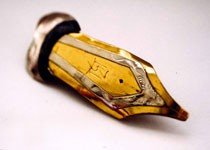 The guide on this unusual journey will be Penna, which symbolizes on the one hand the texts that our ancestors bequeathed to us, so that even today we can use them as sources of inspiration for new creations and on the other hand the fact that the art of artistic jewelry can be another language of communication of timeless messages of the past to the woman of today. It is the first piece of the collection that will lead us, before the beginning of the story, to a symbolic jewel, the timeless Homeric Greek woman, LAKAINA.
 Η Lakaina is an ideal female being, who is embodied through the narration of the myth and each time takes the form of a woman important for its development, either because of her symbolic importance, or because of her leading role, or even because of her status as the mother or wife of an important hero.
Lakaine were the young virgins who represented the city of Sparta at the Helenia festivals. It was also the title of a lost tragedy by Sophocles, which describes the theft of Palladium, a sacred symbol of Athena that protected Troy, by Odysseus and Diomedes. The dance consisted of the women who accompanied Helen and were called Lakaine.
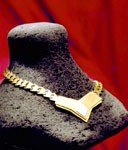
The jewel, which represents the timeless Homeric Greek woman, begins in the center with the symbolic shape of the rhombus, which symbolizes the eternal feminine principle. Based on the lines of the central shape, its outer frame begins to spread out, because suffocation, it wants to create a path of relief and this is the chain, which symbolizes the path of women from antiquity to the present day. We observe that the chain, this path, does not deviate from the lines of the rhombus because each piece of it is also a woman from the distant past to the present day.
Its lines are straight and simple. The jewelry as a whole exudes a power and imposingness, but also has the charm of simplicity. It brings to mind a phrase by Kadinsky that says that "lines have a secret soul that is silent more often than it speaks."
 And our story begins. Once, in ancient Laconia, the sky embraced the cloud-covered mountain peak with its divine power and thus from the union of Zeus and the proud nymph Taygetes, Lacedaemon was born, the man who, as his name suggests, lived in caves and gorges. Her name, according to Hesychius, means great mountain, (greatly built: it comes from τίς or τας which means great, many and the root Ga-gegaa) and is perhaps the reason why the most beautiful mountain in Laconia was called Taygetos, where, according to the imagination of the ancients, gods and spirits lived.
In ancient societies, raw stones had a purely symbolic meaning and were also considered dwelling places for gods and spirits. That is why the jewelry is composed of these elements, the small, uneven stones that symbolize the peaks of Taygetos and have numerous dark spots (patinas) on them that represent the caves, gorges and ravines of the mountain.
Taygeti symbolizes the proud Homeric Lacaena who endures all weathers. She stands with her head held high as befits her, she knows how to resist bad times but also to create ceaselessly when they allow her to. She is a proud woman, who does not bend under difficulties and imposes herself in her space with her dynamic beauty.
 The river Eurotas constantly watered the Laconian land and made it fertile and friendly to Lacedaemon. And he mated with the daughter of the river, Sparta, that is, sowing, fertility, and began to sow the land and reap its fruits, laying together with Sparta the foundations of an entire civilization, which Laconian Mythology so vividly describes, and despite being so wronged, continues to inspire even today those who dare to seek it out.
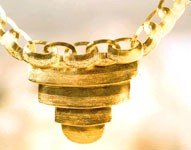
The jewel that symbolizes Sparta begins at its base from a seed, which, growing, bears fruit and gives birth to many others, which come to join in a chain of evolution. It is the evolution of fertility at all possible levels that one can encounter, whether in the body, in the spirit, or in the soul. This seed, multiplying, comes in the form of a chain to be gently wrapped around the neck, as if it were the earth that will keep it alive forever. It is like newborn ideas, which when they find suitable soil, develop and evolve, it is like newborns that safely and tenderly lean on their mother until they spread their own wings. The jewel as a whole symbolizes the mother (central theme), who embraces her children (rings) with an uplifted soul. She is Sparta, the sweet and silent Lakaina, whose work is seen when spring comes. She is a woman who considers the power of fertility a privilege, and creation in any area of life, a prerequisite for joy and happiness. A woman who loves motherhood and seeks ways to utilize the power of creation that she has within her.
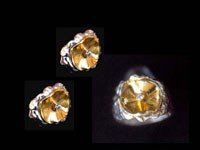 Sparta and Lacedaemon had a son, Amyclas, who became the oldest hero of the Laconian cities and had as his grandson the beautiful Hyacinth, the beloved friend of the god Apollo. One day, in a discus throw competition, Apollo accidentally killed his handsome friend with his discus. The flowers that grew on the bloody ground took his name and since then the Laconians have celebrated festivals every July to honor him, the Hyacinthia.
Taygeti and Sparta were not the only forms of Lakaena, but they were the only symbolic ones. Many others followed, more human, but equally or even more important.
Also son of Amyclas and brother of Hyacinth was the magnanimous Perieres according to Hesiod, who married the beautiful daughter of Perseus and Andromeda, Gorgophone. Her name is an epithet of the goddess Athena meaning "she who killed the Gorgo." Perseus named his daughter this way to honor the goddess who helped him kill Medusa (Gorgo) and save Andromeda from the whale.
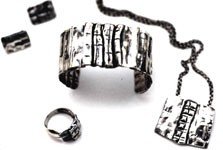 Η Gorgophone was one of the important Laconians of Laconian Mythology. She is the first woman who, after the death of her husband Perieris, did not remain unmarried for the rest of her life as tradition required, but married Oivalos, establishing matriarchal patterns in the ancient world for the first time. Something that became a habit in the following years. Furthermore, Gorgophone is the ancestor of most of the protagonists and protagonists of Laconian Mythology.
The jewel that represents her could have the classic oval or round shape of the shield, since the myth owes its evolution to it. However, I preferred to use this shape based on the parallelogram to symbolize the great change that Gorgophone brought to women's lives with the example of her second marriage, but also to highlight the determination and stability of her character. The folds on the surface and the abstract shapes aim to provoke the reflection of light that scatters and dissolves evil. Exactly what Athena's shield did in the hands of Perseus. The patination gives the sense of the past on which the future is built, which is rendered by the modern lines of the design. The jewelry combines the maturity of tradition with the dynamics of modernity, characterizing a woman who takes life into her own hands and opens new paths and horizons not only for herself but also for the society in which she lives.
Gorgophone had Leucippus, Aphareas and Icarius with Perieres, and Tyndareus with Oivalos.
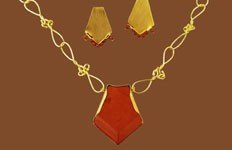 Icarius united with the nymph Periboia and had the well-known Penelope. Her name comes from the coil, which is the weft, and means "weaver" (according to Crusio, coil + lepo = the one who unravels the cloth). She was the wife of the resourceful Odysseus, king of Ithaca, and as Homer describes, she promised the suitors, who were pressuring her to marry one of them, that she would make her choice as soon as she finished the cloth she was weaving, to give it as a gift to the new king. Thus, waiting with undiminished hope and patience for the return of her beloved Odysseus, for ten years, she wove all day long, while at night she secretly unraveled what she had made, with the result that the weaving was never finished.
The jewelry is discreet and delicate. The chain is all hand-woven like the weaving of the heroine it symbolizes. Its elaborate weaving bears the characteristics of the patience and perseverance that its construction requires. The central theme "wrapped" with red enamel symbolizes the flame of love that Penelope hides in her heart, but also foreshadows the joy that comes with the return of Odysseus.
Penelope is the Homeric Greek symbol of marital fidelity and devotion. She is a woman endowed with enormous reserves of patience, perseverance, and an inexhaustible power of hope, who with sweetness and cunning resists difficulties and the pressures of others until the fullness of time comes to vindicate her.
Tyndareus was expelled from Sparta by his brother Hippocoon and fled to Aetolia where he married the beautiful daughter of King Thyestes, Leda. When Heracles killed Hippocoon, he returned to Sparta where he reigned with Leda, and had three daughters with her: Timandra, Philonoe, and Clytemnestra.
Hesiod informs us that when Tyndareus once made a sacrifice in honor of the gods, he forgot the goddess of beauty Aphrodite, which is why she, in anger, destroyed the family happiness of Tyndareus' daughters. Thus, the robust Timandra married the king and hero of Tegea Echemos and later abandoned him to marry Phyleas, son of the king of Elis. Similarly to Timandra, the goddess's revenge continued on Clytemnestra and Helen.
 Timandra, whose name means "I honor valor", married the king and hero of Tegea, Echemos, who had killed Heracles' son Hyllus in a duel. She later abandoned him to marry Phyleus, son of the king of Elis, Augeas. Hesiod refers to her as "robust Timandra".
The design of the jewelry is both classic and modern, giving it an element of timelessness. The wide opening of its two sides in combination with the simplicity that characterizes it suggests a dynamic and free woman, strong not only in body but also in spirit. Because only a woman with a strong character could honor courage, as her name indicates, and determine her future with determination. The sodalite stones that hold the jewelry, imply a certain hardness that such a character can hide without causing disharmony, which is why they embrace the jewelry with their silver-gray highlights, which blend with the color of the metal, and thus create an aesthetically harmonious whole.
She is also a dynamic Lakaina who does not complain, but takes life into her own hands and has the power to change course if necessary.
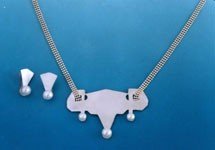 Timandra's sister, the beautiful Philonoe was a woman who, as her name (philos + intellect) indicates, loved the spiritual life. This tendency led her to remain pure throughout her life, and for this reason the goddess of Purity Artemis made her immortal after death.
The shape of the jewelry is not accidental. It is reminiscent of the shape of a womb that was never fertilized. The pearls that adorn it, as symbols of purity, and the soft color of silver come to confirm the symbolism of the theme. Philonoe is Lakaina – a symbol of purity with inner purity, spirituality but also simplicity, which conveys messages of kindness, purity and love.
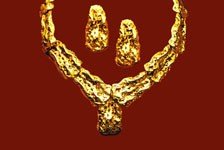 Sister of the two previous ones was Clytemnestra, the wife of Agamemnon, with whom she had three children: Iphigenia, Electra and Orestes. Her name comes from klytos + mnaomai and means she who seeks office. She was not a random woman at all, but a queen whose life brought her face to face with incredible situations. She herself does not have many reasons to love Agamemnon, because before him she was married to the king of Pissa Tantalus, against whom Agamemnon campaigned and killed him along with her newborn child. He then married her and later, in order to sacrifice their daughter Iphigenia to the goddess Artemis, to allow the Greek ships to depart for Troy, he tricked her into telling her that he had to bring Iphigenia to Aulis to marry her to Achilles. However, Clytemnestra never forgave Agamemnon for his actions, and during his ten-year absence from Troy, she became involved with Aegisthus, and he was killed immediately after his return from Troy. She then married Aegisthus, made him king and had three children with him: Irigone (Orestes' concubine), Aleti and the second Helen.
Years later, Orestes, with the help of his friend Pylades, killed Aegisthus and Clytemnestra, and her daughter Helen, but fled, pursued by the Erinyes, and sought protection in the temple of Apollo at Delphi. Apollo told him to go to Athens and seek the protection of Athena. Athena listened to his pleas and established a court of Athenian elders to judge him. The court, which was called the Areopagus and has since tried the iniquities of men, after hearing the indictment from the Erinyes and the testimony of Orestes' defense by the god Apollo, decided, despite the tie among the judges, to acquit Orestes, thanks to the positive vote of Athena, who presided. Engels and Wachoven believe that the above myth depicts the struggle taking place at that time between the disappearing matriarchy and the rising patriarchy. The defenders of matriarchy are the Erinyes and of patriarchy are Apollo and Athena. In the end, patriarchy won.
The jewel, impressive, has the majesty of a queen. The difficult moments that Clytemnestra experienced and their ferocity could only be attributed to the wild surface of the metal. The patinas on it symbolize the dark sides of her character and her intrigues. The jewel symbolizes a dynamic, impulsive and ambitious woman, vengeful when she is wronged, who is not afraid to take risks in order to achieve her goals, which she pursues with intensity of soul.
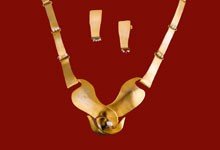 Clytemnestra's mother, Leda, was seen one day by Zeus bathing in the Eurotas and fell in love with her. To conquer her, he sought the help of Aphrodite, who transformed him into a swan and she took the form of an eagle, which chased him. Zeus-swan sought refuge in the arms of Leda, who embraced him with tenderness to protect him. From this embrace, Leda gave birth to two eggs. From one came the Beautiful Helen, and from the other the Dioscuri.
This unique love story, which has various variations, became a favorite subject of many great painters around the world. Thus, we find related paintings in various museums and galleries internationally.
The shape of the jewelry inspired by the figure of Zeus-swan is a complex of soft curved lines that gives the impression of two embraced swans that radiate the tenderness that characterizes their union but also Leda herself. The metal, soft and smooth, like the skin of the tender Lakaena, who is bathed not only in Eurotas but also in the sunlight, shines. The chain that supports it is reminiscent of small pieces of Eurotas' reeds and to complete it aesthetically is decorated with small discreet pearls.
Leda is the representative type of the tender, protective and charming Lakaina whom we will always encounter throughout the centuries.
The Dioscuri, Castor and Polydeuces, were perhaps the most beloved heroes of the Lacedaemonians, who invoked them in wars and considered them protectors of sailors. Polydeuces was immortal, while Castor was mortal. When Castor was killed in a battle with the Apharids Ida and Lygea and Zeus raised Polydeuces to heaven, he did not accept immortality because of his brotherly love for Castor, and Zeus allowed him to share it with him. Thus, Polydeuces lived in the sky during the day and Castor at night, symbolizing the alternation of the Sun and the Moon.
They abducted and married two Lacaenas of rare beauty, the daughters of Leucippus. Castor took Ilaeira, whose name is another name for the Moon, and Polydeuces took Phoebe, whose name will be called Dawn, and Lacaena became a symbol of youth.
 Ilaeira, daughter of Leucippus and Philodike, was a priestess of Aphrodite. Her name is another name for the Moon, and like her, she is a carrier of change, a symbol of universal becoming, resurrection, immortality and the cycles of eternity.
The rhombus from which the main theme of the jewelry begins symbolizes the eternal feminine principle, but opening upwards shows the changes that occur within the circle of eternity as the shape is divided into more parts. It is as if it changes forms and mood, like the Moon. The jewelry is made of silver, which is the symbolic metal of the Moon, and its overall shape, simple and balanced, gives a direction, which in combination with the braided chain symbolizes the eternal movement towards a specific path, thus carving the lines of destiny.
The jewelry as a whole symbolizes a woman who is intelligent, restless, with endless pursuits, who enjoys the variety of life and constant change and renewal. Ilaeira is a Lakaina who possesses quality and knowledge and uses her mind to change everything for the better, following the path towards fulfillment, like the Moon before the full moon.
Phoebe , the sister of Ilaeira, was a priestess of Athena and became the wife of Polydeuces. Her name comes from phaos, meaning light, and means Dawn, another name for Eos. Phoebe was in love with everything that was new and bright. She had kidnapped a number of handsome young men for their beauty and youth. Last of all, she kidnapped Tithonus, for whom she asked Zeus to grant him immortality, but she forgot to ask him for eternal youth. Thus, Tithonus began to age and, remaining immortal in very old age, remained in history as a symbol of ultimate old age. In the interpretation of the myth, Tithonus symbolizes the day that leaves and comes.
The jewel looks a bit like a cloud, a bit like a joyful embrace, ready to accept everything new. The gold element in the center symbolizes the light of dawn, which comes to dispel the fog of the night and the silver light of the moon. The pearls that hold it are the paths of the Moon that leaves, leaving the new day to succeed it.
Phoebe symbolizes the woman who is characterized by youth, not necessarily that of the body, but that of the soul that is eternally radiated. She radiates youth, is not afraid of the new, dares to renew herself, is progressive and innovative and like the dawn that breaks every day, she too brings something new and important to illuminate the course of the world with her own light.
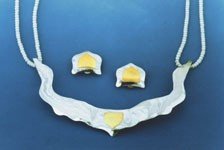 The sister of the Dioscuri Helen , was the most beautiful of mortals. Hesiod writes about her:
"In form she resembled the gold-adorned Aphrodite,
and had shining eyes and graceful movements
like the Graces, the black-eyed maiden"
Her name means "brilliant beauty" and she was so famous for her beauty that the most powerful, brave and courageous kings of all Greece, even the swift-footed Achilles, sought her as their wife. The wise Tyndareus made them promise that if anyone took her by force, all the others would march against him to punish him. She chose the brave son of Atreus and brother of Agamemnon, Menelaus, who after Tyndareus' death became king of Sparta, and had a daughter with him, Hermione.
At the festival of the gods in the cave of the centaur Chiron, which was held for the wedding of the hero Peleus with the goddess Thetis, they forgot to invite only Eris, the goddess of discord. She, in order to take revenge on the gods, took a golden apple, wrote on it “to the most beautiful” and left it without being seen on the table. The gods saw “the apple of Eris”. But who was the most beautiful to give it to? A great dispute broke out between the three gods: Hera, Athena and Aphrodite. Zeus, avoiding being a judge, ordered Hermes and the goddesses to go to the slope of Ida on the outskirts of Troy, where the decision on who was the most beautiful would be made by the handsome son of King Priam, Paris, whom the people had named Alexander (i.e. winner) for his strength and bravery. But Paris looked at them and could not decide. So they began to offer him great rewards. Hera promised to make him king of all Asia, Athena to bring him glory and victory in wars, and Aphrodite to give him as his wife the most beautiful of mortals, Helen, the daughter of Zeus and Leda. As soon as Paris heard Aphrodite, he gave her the apple and declared her the most beautiful among the goddesses. Thus Paris, seduced by the games of the gods, but also enchanted by the fatal charm of Lacaena, abducted her and then the suitors, true to their promise, marched against Troy and captured it after a ten-year bloody siege. The Laconians deified Helen and celebrated the Helenia in her honor.
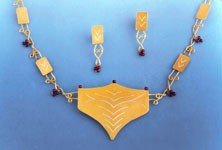 The jewelry starts from a theme that has the shape of a crown, because Helen was a queen. The chain that holds it is composed of graceful lace elements that symbolize femininity and grace and other solid ones, decorated like the central theme with engravings that symbolize how much this myth (or reality?) marked the world. Finally, small beads of garnet, the stone that causes passionate love, symbolically decorate the jewelry, tied like bunches of grapes, from which comes wine, the drink of intoxication and love, which became the reason for the Trojan War.
Helen is a symbol. She is the symbol of real, natural beauty, before which even the gods bow. She is also the symbol of the fatal woman whose passing causes events and situations that indelibly mark History.
 The daughter of the beautiful Helen, Hermione, had a beauty similar to her mother and married the son of Achilles Neoptolemus. However, he preferred his captive Andromache (Hector's widow) to her, so the indignant Lacaena incited the matriarch Orestes to murder Neoptolemus and then married him. From their marriage was born Tissamenos, during whose reign the Dorians descended on the Peloponnese, marking the end of Laconian Mythology.
The jewelry consists of a pendant whose shape has solidity, volume, plasticity and is even more alive with the two metallic colors, which contrast with each other, like the emotions experienced by Hermione. The dark color of graphite symbolizes the bitterness she went through. First when her mother left with Paris, and then when her husband preferred Hector's widow to her. The bright color of gold symbolizes the great changes in her life, which she decisively brought about. Leaving behind bitterness and now living in the light of joy, she moves on to a different life, which she herself defines, and moreover tastes the joy, which she had been so deprived of in the past. The chain with the double elements joined together symbolizes her final union with Orestes.
Hermione symbolizes the intelligent and charming woman, who does not tolerate being insulted and does not forgive being despised. A woman who has the gift of seduction and knows how to use it with determination and effectiveness to deal with life's problems.
Here our myth ends to give way to History. This History that our Homeric Greek woman is called upon to continue with a steady step, looking far and high into the future.
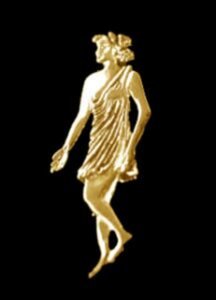 A characteristic piece of jewelry of this connection between myth and historical reality is the Spartan Phaenomeris jewel.
I designed it according to the description of Xenophon who says that the Greeks and especially the Athenians called the Spartan women "Phaenomerides" because when they exercised they wore an outer tunic short to the knees, sewn at the sides, which was held in place with pins and was called "peronitis or peronatris". So when they walked or ran, the sides of the tunic were lifted and their thighs were visible. So these women with the free walk, whose bodies were never imprisoned in their swaddling clothes, had a similarly free spirit and soul and taught the ideal of freedom. An ideal that they bequeathed with their actions to us, the descendants. A legacy that is a precious jewel in Greek History.
The seductive golden veil of Myth enveloped the Homeric Greek woman and made her immortal. Perhaps because the core of Myth seems like a plan of destiny. Perhaps because, as Jacqueline de Romigy says, “myths manage to escape the time that attempts to disguise them, because they have the value of signs and symbols”. Thus, the Homeric Lacaena, from the dawn of History, became a female symbol, became the heroine tested by the fate that sculpted her cell. She is the Homeric Greek woman, who knew the touch of the gods and the bitterness of men. She is the Homeric Greek woman, who never submitted and took her life into her own hands. She is the wonderful, the beautiful, the charming, just as contemporary as us, who without realizing it, we follow and evolve her. He is the inexhaustible source of inspiration. He is a Eurotas, who even today flows through our veins. He is a Taygetos, who sets divine goals for us.
She is LAKAINA, THE TIMELESS HOMERIC GREEK, even if her age is only 3,000 years.
BIBLIOGRAPHY
1. "Greek Mythology" P. Decharme, published by "Useful Books" 1959
2. "Greek Mythology" I. Th. Kakridis, published by "Athens Publishing House" 1986
3. "Ogygia or Archaeology" by A. Stagiritis, published by "Free Thought" 1996
4. "Greek Myths" R. Graves, "Cactus" edition 1998
5. "Great Greek Encyclopedia" by Drandakis, published by "Pyrsos" 1926
6. "History of Civilization" W. Durant, published by "Syropoulou Bros. & Koumoundourea O.E." 1965
7. "Hesiod's The Homerics" edition of "Papyrus"
8. "Hesiod's Theogony" edition of "Papyrus"
9. "Homer's Iliad" edition of "Papyrus"
10. "Homer's Odyssey" edition of "Papyrus"
11. "Plutarch's Parallel Lives, Lycurgus" edition of "Papyrus"
12. "Xenophon's Laconians" edition of "Papyrus"
13. "Laconian Pausanias" edition of "Papyrus"
14. "Great Dictionary of the Greek Language" Liddel – Scott edition "Konstantinides" 1901
15. "Homeric Dictionary" by Krousiou, published by "A. Koromilas", Athens 1876
16. "Homeric Dictionary" by A. Kofiniotou, published by "Palamides", Athens 1886
17. "Homeric Dictionary" Georg Autenrieth published by "P. D. Sakellariou" Athens 1893