
(Their allegory: the spread of Greek Culture in the world, but also the path of the soul towards its deification)
(athlos: aethlos = struggle with toil, pain and suffering)
IMPORT
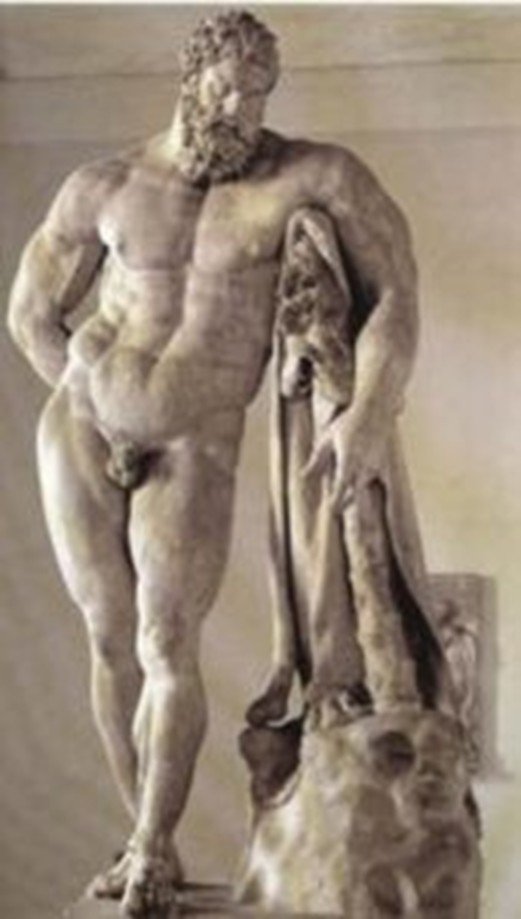
Hercules, marble copy of a bronze work by Lysippus, circa 340 BC. Naples, Museo Archeologico Nazionale.
Hercules is the figure that dominates Greek Mythology more than any other hero of the ancient world. With his exploits and deeds, he transcended the boundaries of local tradition and emerged as a Panhellenic hero. He is the only hero who, after death, is entitled to ascend to Olympus and marry a goddess (Hebe), unlike the rest who live in the Elysian Fields and cannot ascend alongside the gods.
The myth of Hercules spread from Asia Minor to northern Europe and Spain, more than any other myth of antiquity. He is the mythical Panhellenic hero who followed the fortunes of Greek Civilization, who, breaking and surpassing geographical boundaries, took on global dimensions.
He became the model of the strong, fearless hero and the extension of an ideal that is also found in other mythologies, but in Greek it is more complete and more complete. With his exploits he is now found everywhere, as an assistant to the gods in the Gigantomachy, but also their challenger on the side of humans. With the development of his myth he becomes a bearer of civilization and savior of humanity, an embodiment of the expectations, hopes and perceptions of the people who created him. Thus, in addition to being simply heroic, he becomes a morally complete figure.
The feats of our hero (although there are also variations of them), symbolize allegorically, the spread of Greek Culture but also the purification of the human soul from its defects. Through the mythological paths, the hero comes into conflict, not with monsters or villains, but with the negative characteristics of the dark side of human character. In the way he carried out his feats, he shows us the true way of our liberation from the inner beasts that lurk within us. Heraclitus, referring to Hercules, considers that: "the two opposites coexist in the same organism, where they compete with each other and instantly replace each other in the power of the mind and soul".
"Hercules was of a noble nature and was the first mortal who spontaneously handed over the dead to the enemy for burial." (Plutarch, Theseus 11.29)
Hercules is neither Superman nor Batman , he is neither a crime hunter nor a protector. He is first and foremost a heroic moralizing figure. Through his action he seeks perfection, confronting the elements of evil that exist within him by highlighting his personal virtues.
Hercules teaches, through his labors and side jobs, a way of seeking and spreading knowledge, but also the path to the immortality of the soul. He overcomes evil at its base and promotes important, for all humanity, moral and cultural values that lead it towards its social perfection. And for this reason, his legend from history became a myth and gradually a philosophical attitude to life.
The myth, in its course through the centuries, as it became the subject of elaboration by poetry and art, underwent a process of "enrichment". The epic, lyric and dramatic poetry, comedy and historiography, dealt with it to a large extent. The depictions in painting or sculpture reached such completeness that some preserved incidents not mentioned in the written sources.
The Jewelry Collection "The Labors of Hercules " is the visual representation of the Labors and at the same time, with the texts that accompany it, it becomes the vehicle of real information, as it has been given to us by our ancient texts and sources. This information will constitute the information and response to the usurpers who internationally exploit the name and dynamic personality of our mythical Hero and distort it. They hide the values for which the Hero fought, they reduce him to the level of a "television warrior" who possesses modern martial arts and they transform him into a symbol without messages. They also place him in times much later than the thousands of years BC that the myth evolved, which is mentioned by Hesiod and by Homer in his Epics (e.392, i.362, vol. 95).
They may be aiming to demystify an Ecumenical Hero who left his indelible mark on the whole of Europe, and not only, but also on Africa and Asia Minor. Something that is clearly demonstrated especially in his Athlos “The Oxen of Geryon” but also in the “Apples of the Hesperides”. It is no coincidence that the Latins, the Scythians, the Gauls, the Celts, the Lydians, consider themselves to be descended from his own divine lineage.
The Labors of Hercules teach the fight against human weaknesses, the spread of knowledge and culture, respect for the gods, healthy standards of action and life, such as those inherent in Greek tradition and which form the basis of ancient Greek but also modern Western civilization.
THE MYTH
BIRTH – CHILDHOOD – EDUCATION
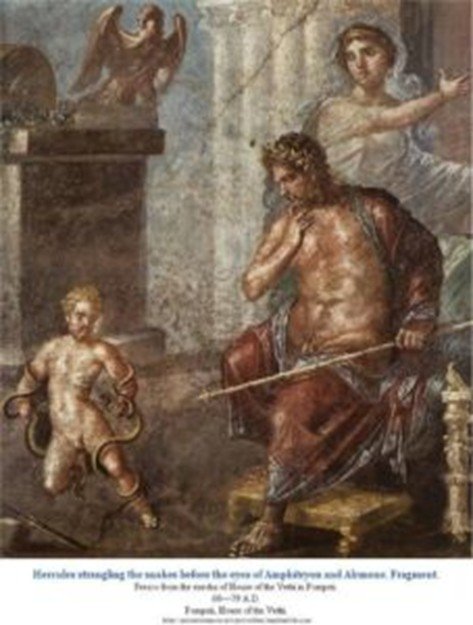 Then, in those mythical years when the gods communed with men, Zeus, taking advantage of the absence of Alcmene's husband, Amphitryon (he was on a campaign), took his form and went to her room, while a golden rain was falling around. After offering her great gifts, he united with her. Previously, he had asked the Sun not to rise for three days. That is why Hercules, who was born from that night, was also called Tricesperos or Triselenos.
But on the third night, after Zeus had already left, Amphitryon returned and slept with her. Thus, Alcmene conceived Heracles (Alcides) from Zeus and Iphicles from Amphitryon.
Zeus' desire to unite with Alcmene was not accidental, as with so many other mortals, but he wanted to make with her the strongest and bravest among mortals. The one who would redeem people from suffering. That is why she was the last mortal he united with.
Zeus then boasted that the child born on a certain day would rule over all others, because he was of his own divine lineage. As soon as Hera learned of this, she wanted to take revenge on him and, with the help of the goddess of deceit Attis, she convinced Zeus to swear that whichever child was born first on that day would rule over all the Argives. Then she helped Sthenelus' wife to give birth to Eurystheus prematurely, so that he could rule.
When Zeus realized the deception, he banished Atti from Olympus forever (since then she has lived only among humans) and forced Hera to agree that Heracles would remain in Eurystheus' power, as long as necessary, to perform ten labors and that when he later died, he would become immortal.
After Alcmene gave birth to the two children, Hera who was possessed by anger and hatred, sent two snakes to devour the infants and while Iphicles began to cry, Heracles grabbed them and choked them with his hands. Alcmene and Amphitryon saw this and immediately understood that he was the child of Zeus. Then Amphitryon called the seer Tiresias who prophesied that Heracles would be glorified among men and would accomplish many feats. According to Diodorus, after the feat of the snakes, the child, who until then had been called Alkeides (after the name of his grandfather Alcaeus), took the name Heracles , because on the occasion of Hera he acquired kleos (=fame).
A very beautiful myth accompanies the first contact that Hera had with Hercules, without her knowing it. When he was born, the goddess Athena took him and took him to Hera to suckle him. Hera suckled him without knowing who the baby was, and at some point Hercules bit her. The goddess was in pain and as she forcibly removed him from her breast, her divine milk was scattered. This resulted in the creation of the Milky Way.
The above myth foreshadows the hero's apotheosis, because at that time it was believed that anyone who was suckled by Hera became immortal.
When he reached the age of education, as was customary at that time, he was apprenticed to the best teachers. He learned letters and the guitar from the old Linus, the bow from Eurytus of Oechalia, grandson of Apollo and a famous archer, music from Eumolpus and wrestling and boxing from the son of Hermes, Apralikus or Autolykus. The art of chariot racing and horse riding was taught to him by Amphitryon himself. Finally, Castor, son of Hippolys, taught him to use weapons, the spear and the shield in battle, and to fight as a leader in the phalanx. He also had teachers Rhadamanthys, the Centaur Chiron and Thespius.
We see that he was given the best education possible. This alone can explain the great cultural work he did during the performance of his feats and throughout his life. This education helped him to face his violent character and his defects and always end up recognizing evil and fighting it. Whether this evil was "within" him, or around him.
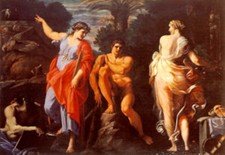
Hercules on the Path of Virtue and Vice. Work by Annibale Carracci, 1596, Naples, Museo di Capodimonte.
He turned Hera's evil into good. The orders given to him by Eurystheus were intended to torture and exterminate him, because behind them lay Hera's hatred. However, the benefits that resulted for himself and for humanity from the performance of the Labors were due exclusively to his own will and the fight against evil, which he encountered in all its forms and defeated.
A myth preserved by Xenophon tells us that Hercules, sitting at a crossroads, saw two maidens, Virtue and Evil, passing in front of him. Virtue, dressed in white, pure, modest and decent, told him that if he followed her she would not deceive him. Her path would be difficult and difficult, but it would lead him to do good deeds. If he wanted the gods to love him, he would have to worship them. If he wanted people to love him, he would have to benefit them and if Greece wanted him to love him, he would have to do good deeds for her.
The other daughter, who was fat and provocatively dressed in transparent dresses and a provocative look, said to him: if you follow me, I will lead you to the most pleasant path. You will have all the pleasures and enjoyments, you will not know wars and you will acquire everything without work and effort. Hercules asked her what her name was and she replied that those who love her call her Bliss and those who hate her call her Evil. Hercules decided to follow Virtue, preferring to suffer to walk her difficult path, but to know glory and honor with his good deeds and virtue.
Xenophon's myth also signifies that man has the freedom of will to follow the path he chooses. Hercules does not suffer what his fate may have decreed, but rather he decides.
At the age of 18, he performed his first feat by killing the lion of Kithairon, which was devouring the herds of Amphitryon and Thespius.
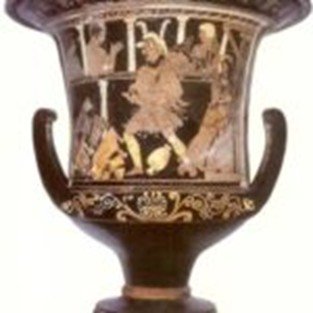
Hercules raging, unique depiction. Behind him the terrified Megara. Krater 330-325 BC. Madrid, Archaeological Museum
Then he went to Thebes, which he liberated from the Minyans, to whom the Thebans paid tribute, and as a reward Creon gave him as wife his daughter Megara as well as the power of Thebes. With Megara he had 8 children. However, Hera sent him madness and a rage of murder and destruction and so in a fit of rage, he killed Megara and the children and threatened to kill Amphitryon, who intervened to stop him. Fortunately, however, Athena intervened and threw a stone at his chest, throwing him into a deep sleep, similar to death (this stone was called the "execution stone").
Hercules then went to the oracle of Delphi to learn how he could atone. The oracle sent him to Tiryns for 12 years, as a servant of Eurystheus, who reigned in Mycenae. There he would have to perform ten labors. Then he would become immortal and ascend to Olympus with the immortals.
SPORTS – SIDE EFFECTS – ACTIVITIES
His adventures and feats were collected and classified into three categories: the twelve labors , which include everything that Hercules performed at the behest of Eurystheus, king of Argolis; the paraerga , which are the feats and adventures that occur in the interval between two labors or while a labor is being performed; and finally the acts , which include feats he performed in campaigns and wars of conquest.
His 12 labors were first codified in the first half of the 5th century (475 BC) on the metopes of the temple of Zeus at Olympia. Six adorned the exterior of the metopes of the pronaos and six adorned the metopes of the apse of the temple.
Before he set out to perform the feats, the gods offered him many wonderful gifts, but he preferred the club, the bow, and the quiver of arrows. The club with the bronze tip that Hephaestus had given him was the opposite. He erected one from a wild olive tree of Helicon, which he replaced with one from a piece of wood he cut from the Saronic coast. He placed the latter on the statue of Hermes in Troezen and it sprouted, grew and became an imposing tree (Euripides, Pausanias). The wild olive tree was considered the tree of the new year and its branches drove away evil spirits.
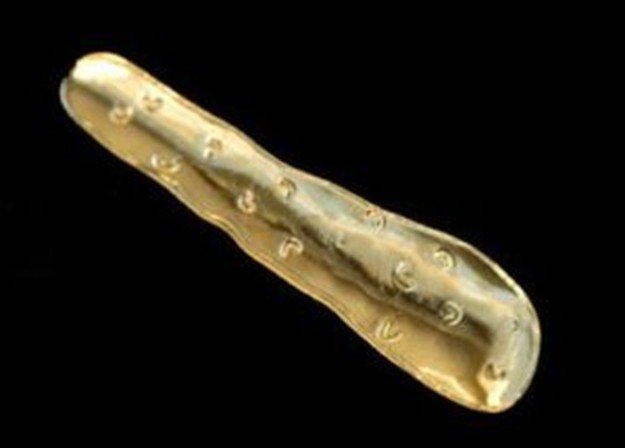 The jewelry is inspired by the club of Hercules and has embossed elements that give it the details of wood.
(Eurystheus did not recognize ten of them).
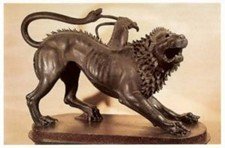
"The Chimera" brass, 360 BC Florence, Archaeological Museum
THE LION OF NEMEA
The first labor that Eurystheus ordered Hercules to do was to destroy the Nemean lion , which according to Hesiod (in the Theogony) was born from the union of the Chimera (=the last year's ram, goat, goat) with Orthros, because he considers that the lion shares the nature of both, since before becoming the king of animals he was above all an object of terror. The Chimera is the monster of the storm, while Orthros is synonymous with the twilight. The lion was raised by Hera and is said to have been sent by the gods to punish the inhabitants of Bembina (a county of Argolis near Nemea), because they had neglected the sacrifices. That is why they had given the lion the name "Bembinitis". The beast was invulnerable and its skin could not be pierced by either a sword, a spear, or an arrow.
When Heracles reached the road from Argos to Corinth, he met Molorchos (according to some a king, according to others a poor shepherd) with whom he agreed to slaughter his only ram in 30 days as a sacrifice to Zeus-Savior if he returned victorious having destroyed the lion, or to sacrifice it for Heracles himself as a hero if the lion had eaten him.
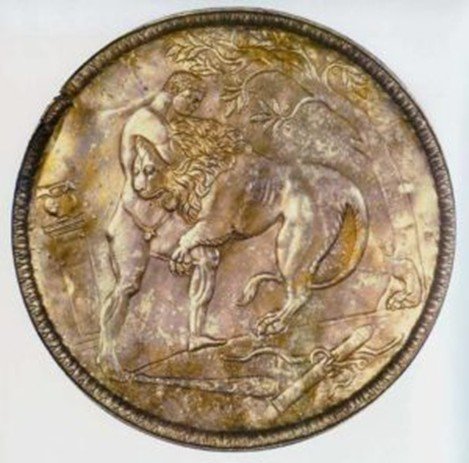
The fight with the Nemean lion, silver disc 6th century BC Paris, National Library
When he met the lion, he tried in vain to hit it with his bow, his sword and his club. The lion entered his cave, which had two entrances. Hercules closed one entrance with stones, entered through the other entrance, fought with it and killed it with his own hands. Returning from the mountain with the lion on his back, he passed by Molorchos and, as they had agreed, sacrificed his ram to Zeus-Savior. In memory of this victory, Hercules ordered games to be held in Nemea, which were called "Nemean" , and where the winners were crowned with leaves of the wild moon.
Finally he returned to Mycenae (they took their name from Inachus' daughter Mycenae), where Eurystheus was so afraid of him that he forbade him from entering the city again. He was to show him the trophies and certificates outside the walls and his orders for the labors were to be sent to Heracles by a messenger, Copreas. Heracles kept the skin of the beast in memory of his labor and wore it as armor with the beast's head as a helmet.
Symbolism: The cave, which also symbolizes the womb, is a cosmic center, a place where man meets the divine, which is why gods and Saviors are born in caves. The northern entrance of the cave belonged to men, the southern to the gods. Thus, Hercules, with his first labor, began his journey towards immortality.
The Nemean Lion, as a beast, represents the "beast" that every man hides within himself. He fought this "beast" with his bare hands, all alone, without using the weapons that the gods gave him to help him perform his feats.
Hercules the "man" must face the "beast" without external support and emerge victorious.
He closed the cave and fought with the beast, he came face to face with the "beast" that was hiding inside him, that is, his own self. He managed to win without weapons and other aids. Today we could say that man should face the "beast" that is hiding inside him, with his own powers without external help which could be medicines or drugs. Hercules fought and came out of the cave that symbolizes the womb, reborn in terms of this specific part of himself. We are called to do the same, fighting with our own powers alone. Because only then will we have managed to become better, since we will have known and fought our specific flaw.
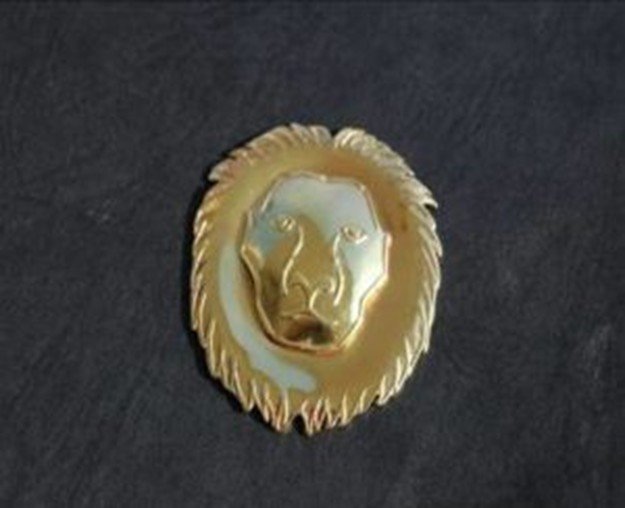 The feat as a jewel is represented with a lion's head in variations, sometimes engraved and sometimes embossed on pendants, earrings, rings and cufflinks.
THE LERNAIAN HYDRA
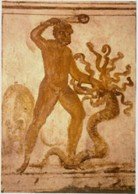
Hercules kills the Lernaean Hydra Painting from a catacomb in Rome, 4th century AD
In his second labor, Hercules was ordered by Eurystheus to kill the Lernaean Hydra, a snake-shaped monster, child of Echidna and Typhon, that lived in the region of Argos. Its nest was on a hill, next to the lake at the Amymone spring, which was shaded by a huge plane tree. It had a repulsive appearance and a huge body with 9 heads, which spewed fire and their breath was poisoned. This resulted in everything in the plain being destroyed . It is believed that the Lernaean Hydra was resurrected by Hera to destroy Hercules.
Lerna had a sacred grove of plane trees, which reached the sea and was between two rivers, the Pothinus and the Amymones. There, every year, secret nightly ceremonies were organized in honor of Dionysus as well as the mysteries of Lernaean Demeter, which were held in a fenced area from where Hades and Persephone descended to Tartarus.
This sacred area was terrorized by the Hydra and Hercules asked for the help of his friend Iolaus to confront it. When they reached the lake, the monster was hidden in its lair and Athena, to help Hercules, put a plan in his mind. He fired his arrows and threw them into the monster's lair and thus forced it to come out. Then the monster wrapped itself around Hercules' leg, and he began to fight it without a moment's hesitation. But where he cut off one head, two immediately sprouted in its place.
As soon as Hera saw that Hercules was resisting so strongly, she sent a crab to bite his leg. Hercules stepped on the crab with force and killed it. Hera then, to honor the crab, raised it to the sky, transforming it into the constellation Cancer. The Orphics interpreted Cancer as the threshold through which souls pass to be incarnated.
But the fight with the Hydra was not over and then Hercules asked Iolaus to light a fire on branches and burn the Hydra's necks where he cut off the heads, so that new ones would not grow back, and thus the two heroes destroyed the monster. The middle head of the Hydra was immortal, so Hercules buried it deep in the earth and covered it with a heavy stone. Then he took the lifeless body and dipped his arrows in its bile, which from then on became deadly. Returning to Eurystheus, he announced that he had done the feat, but Eurystheus told him that he did not recognize him, because he had done it with the help of Iolaus.
The myth finds its historical interpretation in the draining of the marshes of Lerna and the liberation of the inhabitants from marsh fever. The multi-headed Hydra obviously indicates the many springs of Lerna and the infectious exhalation the poisonous fumes and diseases that came from the lake. Recent research in the area of the Argolic Gulf revealed that the site seems to have large oil deposits, from which natural gas certainly emerges. It is therefore not unlikely that the Lernaean Hydra was one of the sources of petroleum products of prehistoric Greece.
Symbolism: On a symbolic level, there was a belief that lakes were entrances to the underworld.
The feat of the Lernaean Hydra symbolizes man's battle with evil. The "Lernaean Hydra" expresses the forms of evil and the dirty thoughts that people create and spread in the environment, and which are represented by the "marshy area".
Thus evil never ceases to give birth to new forms of evil, which is why it must be confronted with the fire of purgatory. Knowledge gives us the ability to locate evil, to uncover it, to reveal it and to spread it so that it may be known. Then, coming into the light of publicity, it loses its power and those who serve it are revealed.
Thus the light of truth destroys it as it did with the fire used by Hercules. But we must always keep in mind that evil is hidden somewhere and has not been destroyed forever , because that is its nature. It is the main head of the Lernaean Hydra that remained unscathed, it is the evil that has taken root and continues to exist. We certainly become better and more useful in society when we learn to recognize evil, to confront it and to make it known.
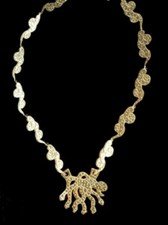 The feat as a jewel is represented by a necklace that resembles the body of a scaly snake with many heads, the elements that make it up have soft lines full of movement and the relief designs represent the theme of the myth. The jewelry is also an apotropaic amulet because it symbolizes the victory of good and knowledge. The set is accompanied by matching earrings.
THE ERYMANTHIAN BOAR
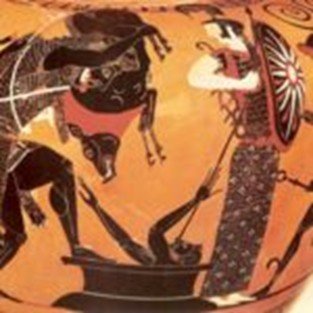
Hercules takes the Erymanthian boar to Eurystheus, who has hidden in the pitcher. Black-figure amphora, 510 BC. Louvre Museum, Paris
The boar was a huge beast, terrifying in appearance, which Heracles had to capture alive on the slopes of Erymanthos (a mountain dedicated to Artemis), in the vicinity of the city of Psofida, in Arcadia. This wild boar ravaged the area and even ate people. No one could face it, because it had enormous strength, speed and endurance.
On the way to Erymanthos, Hercules was hosted by his friend the Centaur Pholos, who prepared a rich table for him, and at one point opened a large jar of fine wine. Hercules indulged in the pleasure of good food and intoxicating wine. The other Centaurs became angry, because the wine belonged to everyone, and Hercules, drunk, attacked them first with burning torches and then with the deadly arrows of his bow. The Centaurs ran to save themselves, but Hercules, out of control, chased them and they went to hide in Chiron's cave. Enraged, he entered and shot the first Centaur he found in front of him, thus killing his friend Chiron.
Repenting of his behavior, he continued his journey to Erymanthos and the boar hunt. He took him out of the forest with loud cries and led him to a pile of snow, where the boar sank into the snow and could no longer run. He jumped on its back, chained it and carried it to Mycenae. Eurystheus, as soon as he saw the enormous boar, hid in fear in a large bronze jar that he had made for such occasions. Hercules killed the boar and wore its skin along with the lion's, and it is said that its tusks were kept in the temple of Apollo in Kyme, Italy.
It is possible that the ancient populations of Arcadia indicated with the image of the boar the river Erymanthos, which during the winter and early spring became a furious torrent that flooded, from the water of the melted snows of the high mountains from where it originates. It destroyed the valley of Psofida and discharged into the Alpheus. Thus, Hercules, as a solar god, could be the summer sun, which, drying up the waters, binds the fury of the torrents.
Symbolism: The Erymanthian boar symbolizes the passions and abdominal pleasures that make man lose control and commit ugly and dangerous acts that can cost him his entire life. The same message is sent by the case of Calypso with Odysseus, as well as Circe, who transformed his companions into pigs - boars-, animals whose only pleasure is to feed on the mud of the earth. Heraclitus will also refer to this human weakness and will say "the pleasure of a pig is different from that of a man".
During the ordeal, Hercules fell victim to drinking and feasting with the Centaurs, reaching a point of losing control and harming his friends and not only that, but he also took the life of his good friend the Centaur Chiron.
The capture of the boar symbolizes the control a person must have over the weaknesses related to matter and not fall victim to them. To be able to live without them ruling him and destroying his life. By fighting these passions and weaknesses, a person becomes better.
The feat as a piece of jewelry is attributed to a necklace whose main theme is inspired by the shape of the boar's protruding teeth, which close in an oval shape and are decorated with lines that emphasize and highlight them.
THE KERYNITIS DEER
Once Artemis had gone out to Mount Parassius for hunting. There she met five beautiful doe with golden horns. She was amazed by their beauty and wanting to possess them, she chased them, caught four and harnessed them to her chariot, but the fifth escaped her, because Hera wanted it that way, and took refuge in the mountain of Kyrenia on the borders of Argolida and Achaia. From there she got her name.
This sacred deer, with its bronze hooves and golden horns, was to be brought alive by Hercules to Eurystheus. Hercules chased her for a whole year. Finally, in order to catch her, he wounded her slightly. Then Artemis became very angry, but her anger subsided when Hercules explained to her the reason for doing this act. So Hercules showed Eurystheus and the Mycenaeans the deer and the labor was over.
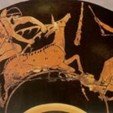
Hercules and the Cerynitic Deer. Red-figure Cylique 480 BC Louvre Museum, Paris
Symbolism: The deer symbolically depicts meditation, gentleness and kindness,it is associated with light and is a symbol of growth, progress and longevity. From a mythological point of view, the feat seems to be related to the Idaean Hercules, whom the Gauls identified with Ogmius, who invented the Ogamic alphabet and the legends of the Welsh.
For a year, Hercules hunts the deer, he must first exhaust his earthly body, so that he can approach it and capture it. Hercules carried the prey in his arms with tenderness, to set it free again to the gods to whom he apologized.
The feat symbolizes the struggle that a person must give, and the time that a person must dedicate, in order to conquer and understand tenderness, patience, kindness and even to express them with love. Then he will learn to behave with love, understanding and tenderness similar to that which Hercules treated the beautiful deer when he carried it in his arms to deliver it by performing the feat. Finally, the deer was returned to Artemis, an act that shows that every contact of man with acts of kindness and love towards those around him, is an acceptance of God's gifts which seem to be returned back to be shared with other people.
The feat as a jewel is attributed with a complex consisting of an embrace, the hooves that have the shape of a horseshoe, which as a shape is considered to bring good luck, but also the characteristic antlers of the deer that are symbolically associated with the "tree of life" while the deer itself is associated with good celestial forces. The jewel, from the interpretation of the symbols it bears, can be considered a powerful amulet. But also a symbol that expresses conscious love and tenderness as well as longevity.
THE TYMPHALID BIRDS
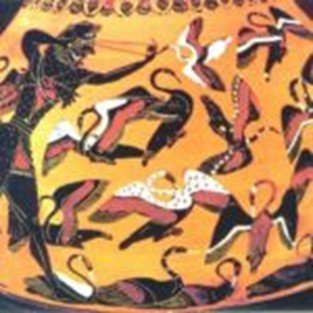
Hercules and the Stymphalian Hens. Attic black-figure amphora of 530 BC. London. British Museum
Hercules had to drive away from the marshes of Stymphalia the countless copper-billed, copper-clawed, copper-winged birds, which shot copper arrows from their wings. When he reached the marshes surrounded by dense forests, he realized that he would not be able to drive them away with his arrows, and then Athena appeared and offered him a pair of copper rattles made by Hephaestus. Hercules climbed the hill of Kyllini and began to bang the rattles, causing such a noise that the birds were frightened and rose into the air and fled.
According to others, the Stymphalian hens were women, daughters of Stymphalus and Ornitha, who were killed by Hercules because they refused him hospitality. In the ancient temple of Artemis of Stymphalia there were representations of the birds and behind the temple were statues of girls with bird legs.
Hercules is here glorified as a healer, who drives out the demons of fever, which are identified with the birds of the swamp. The chickens are personifications of fever. In early times (in primitive peoples even today) they drove out the demons of fever with rattles and rattles. Making noise with bronze objects was a ritual act that was still used to prevent storms and bad weather in general. Artemis was the goddess who could cause fever or cure it.
The area of the Stymphalia swamp was growing significantly and at one point something blocked the underground tunnel from which its waters were channeled. It is likely that Hercules drained the swamp and freed the tunnel.
Symbolism: On a symbolic level, Hercules received help from Athena, who symbolizes the mind. The swamps symbolize the stagnation of people's lives, who remain inactive without any reaction to what happens to them in life. The action of the chickens symbolizes the spearing of forms of evil towards others. Their greatest fear is that they will be exposed (brazen). The means of dealing with them is the publicity and disclosure of evil, the resounding truth has the power to eliminate it, which is why Hercules made a bang bigger than the chickens (publicity) and drove them out.
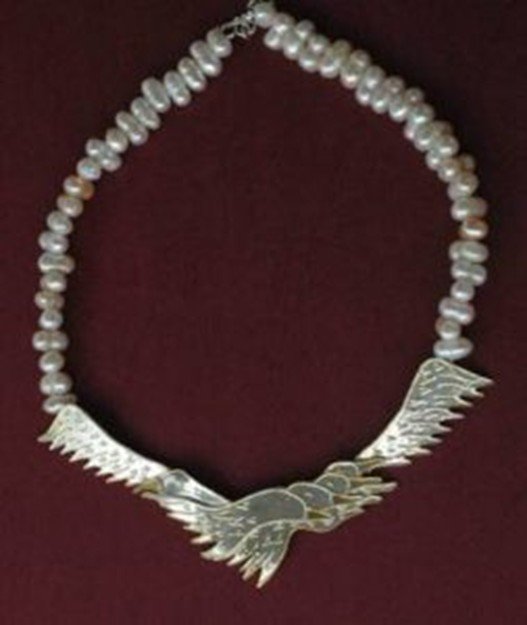 The feat as a jewel is attributed to a necklace whose main theme consists of elements bearing relief figures of birds flying and creating a commotion. The pearls that hold it together symbolize the purity and peace that follow after the feat is over.
THE STABLES OF AUGEAS
Hercules had to clean the stinking stables of the king of Elis, Augeius, who was the richest man on Earth in sheep and cattle, which were incomparably fertile. Because the stables and pens had been years in the making, the stench contaminated the entire Peloponnese. Hercules offered to clean them before dark in exchange for 1/10 of the animals, or a portion of his kingdom. Augeius' son Phyleus agreed to be a witness and auditor. Augeius made him swear an oath, and he swore for the first time in the name of his father, Zeus, something he never did again.
Hercules rejected the idea of carrying the manure on his shoulders as a task unworthy of his reputation, in order to avoid the shame of the insulting order. With the help of Iolaus, he knocked down the stable wall in two places, dug a deep ditch that passed through the fields and stables of Augeas, and then diverted the rivers Alpheus and Peneus or Menius from their beds, so that their waters would flow rapidly and carry all the manure to the sea. Then they rebuilt the stable wall, and thus the labor was completed in one day. Augeas learned that Eurystheus had given the order for the cleaning and refused to pay him, despite the testimony of Phyleus about the agreement he had made. Eurystheus refused to count the labor, believing that Hercules was in Augeas' employ. Later, Hercules, in order to punish he led Augeas against him, killed him, and made Phyleus king of Elis. In memory of this victory, he organized the first Olympic games in Olympia.
In art, the feat is depicted for the first time on the facade of the temple of Zeus at Olympia. Helios is mentioned as the father of Augeas. This view is reinforced not only by his origin and the etymology of his name (Augias = bright, dawn), but also by the fact that he feeds the oxen, which are sacred animals of Helios. This does not mean that Augeas was the human form of the god Helios, but it is said that he was the leader of the Elis tribe who worshipped the Sun.
Symbolism: The labor symbolizes the self-respect that a person should have and the effort that he must make to preserve his dignity. Hercules wanted to avoid direct contact with dung and filth (they symbolize the corresponding people). He demolished the stable walls and diverted the clean water of the rivers which, passing by, carried away all kinds of impurity.
He broke down the “dams” of the established flow of the rivers Alpheus (Alpheus = concentration of light) and Peneus (Peneus = subordination of matter to the mind), which isolated people from the rivers of purification. Natural elements and water cleanse people from the dirt that has accumulated over the years. Even today, baptisms, purifications with water (sanctification) change from people to people, from religion to religion, but they symbolize the same thing. He restored purity among human relationships, without a desire for projection.
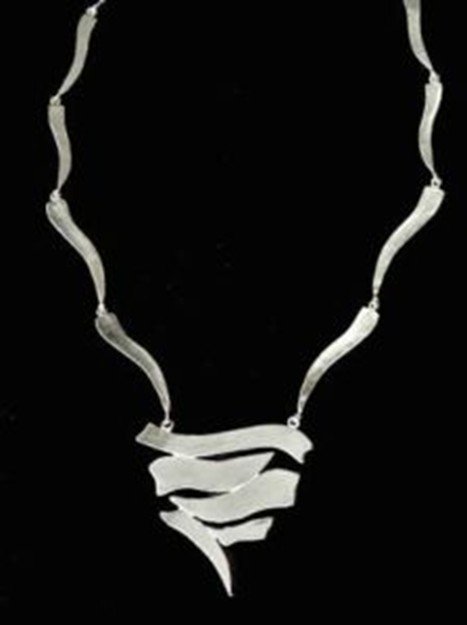 The feat as a jewel is represented by a necklace consisting of silver elements that are connected in such a way as to give the impression of water waves, like those of the two rivers that bring about purification and rejuvenation. The surface of the metal is not smooth, it is almost embossed to show that the water, while cleansing, left its marks, because after purification, nothing is the same. The set is completed by matching earrings, a bracelet and a ring.
THE BULL OF CRETE
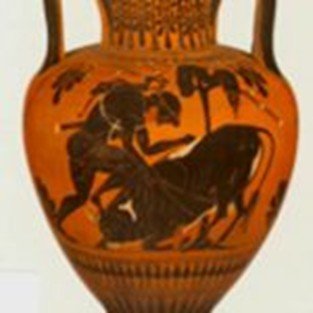
Hercules and the Cretan Bull. Attic black-figure amphora, 520 BC. New York, Metropolitan Museum
The bull of Crete was a wild animal that brought forth fire and spread destruction everywhere. It is said that Zeus, when he abducted Europa, did not transform into a bull, but fled from Phoenicia with her on a bull, which he then set free after arriving in Crete. After a while, however, the gods sent madness to the bull, which left the palace in a rage and returned causing destruction. According to another version, it is the bull that Poseidon had sent to Minos to sacrifice in his honor, but Minos, enchanted by its beauty, kept it in his herds. Then Poseidon, in anger, sent madness to the bull and it began to cause enormous destruction in the region and no one could confront it.
This bull was ordered by Hercules to catch it and deliver it to Eurystheus alive. Hercules, after a great effort, succeeded and caught the bull, tied it up and swam with it to the eastern coast of the Peloponnese. From there he took it on his shoulders and brought it to Mycenae. Eurystheus admired the beautiful animal and wanted to dedicate it to Hera. But she refused, because she did not want to accept as a gift something that would remind her of Hercules' success and thanks to which his fame grew more and more. Therefore, she set him free and he passed through Argos, Sparta, Corinth, the Isthmus, Attica, causing much destruction and ended up in Marathon where Theseus caught him and offered a sacrifice to the gods.
This myth attempts to create a single mythological space that includes both Argos and Crete (for which we have an inscription where Argos is considered the metropolis of Knossos), as well as Attica with the myths of Theseus.
Symbolism: The bull is usually the masculine principle in nature, the solar reproductive force attributed to all the celestial gods, the male sexual power, kingship. It also symbolizes the earth and the liquid nature of nature. The bull's roar symbolizes thunder, rain, fertility. Fighting with the bull is one of the ritual feats that candidates for the great royal office had to overcome. Hercules, as a future god, had to go through this ritual.
The Cretan Bull symbolizes uncontrollable power, beauty, but also passions and desires. By capturing the Bull, Hercules showed that all of the above is possible, and must be tamed by people so that they can acquire knowledge to organize and live their lives better. The Bull crossed Sparta, Arcadia, passed through the Isthmus and reached Marathon. The capture is intellectual, it will gain knowledge and understand passions of the soul which it will investigate. Then we will have: dissemination of the word (Sparta), proclamation of a principle (Arch(k)adia), spiritual path (Isthmus) and immortality (Marathon).
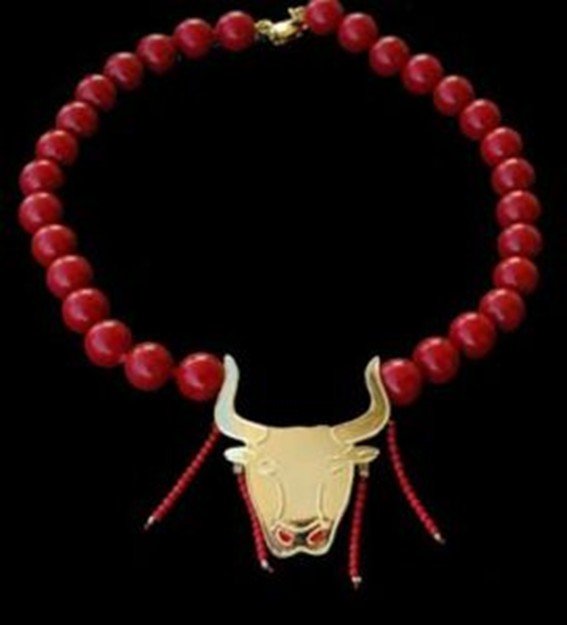 The feat as a jewel is represented by a pendant with a relief of the form of a bull. It is held by two rows of coral, which is considered the stone of longevity and an amulet. Its red color symbolizes passion and strength. The set is completed by earrings with coral, and they are decorated with enamel.
THE MARES OF DIOMEDES
Hercules and the Mares of Diomedes, 6th century BC. Attic black-figure kylix, Hermitage Museum, St. Petersburg
Eurystheus ordered Hercules to capture the four wild mares of the Thracian king Diomedes, who reigned among the Vistones. He himself kept the mares bound with iron chains in bronze mangers and fed them with the flesh of his unsuspecting guests. (According to others, they were not mares but kylons, i.e. breeding horses, stallions, and were called Podagro, Lampona and Xanthos or Deinos). According to one version, these horses threw fire from their nostrils, gave birth to other destructive horses and when they could not find victims, they ate each other.
Hercules , arriving at Tiris, defeated the grooms of Diomedes and led the mares to the seashore, where he entrusted them to his friend Abderus, while he himself returned to repel the Vistones who followed him and whom he defeated thanks to his ingenuity. That is, he dug a tunnel with which he flooded the plain lower than the sea surface, put them to flight, hit Diomedes with his club and threw him to the mares, who tore him to pieces. In the meantime, however, the mares had destroyed the chariot that Abderus had harnessed to them and had torn him apart as well. After they had satisfied their hunger, Hercules managed to tame them. At the spot where he buried his friend, Hercules founded the city of Abdera and established games in Abdera's honor, which included all sports except chariot racing. He then returned to Mycenae where he handed the horses over to Eurystheus, but he became afraid of them and set them free. The horses wandered all the way to Olympus, where they were devoured by wild beasts.
We encounter the myth for the first time in Euripides' "Alcestis", because while Hercules was going to get the horses of Diomedes, he visited his friend Admetus and saved Alcestis' wife by fighting and defeating Charos, who was about to take her. The adventure is incorporated by Euripides into the twelfth labor and was performed in 438 B.C.
Symbolism: These evil horses represent thoughts of evil. The mares gave birth to more and more young destructive horses.
Symbolically, it gives us the ability of thought to give rise to other thoughts, in this case evil ones. When the horses did not find victims, they ate each other. The horses of Diomedes were the personification of human evil, which when it does not find suitable ground turns against itself. Hercules tamed them and thus allowed all the virtues symbolized by the "horse", intelligence, wisdom, logic, nobility, agility, innocence, light and life, to be freed and become the property of people. The myth wants to point out that people like Abderas, who are easy targets for destruction, should not be left unprotected by evil. When man understands his instinctive powers, then he becomes "rational" and abolishes the "unreasonable" forces that push him towards evil.
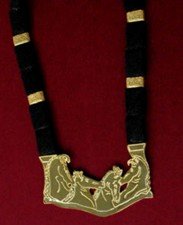 This feat is represented as a jewel by a necklace with a central theme of the embossed heads of horses that coexist peacefully, now that evil has been exorcised, and is held by lava stones. Now all the virtues symbolized by the horse come to the surface and now play the role of a talisman.
THE BELT OF HIPPOLYTE
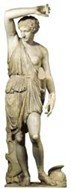
Wounded Amazon. Phidias, 440-430 BC. Copy, Capitoline Museum, Rome
Heracles had to bring for Eurystheus' daughter Admita (= unmarried, unmarried, virgin according to Crusius) the golden belt of Ares, worn by the queen of the Amazons Hippolyta. He headed to the Thermodon River in the Black Sea, along with Iolaus, Telamon, Aeginetis, Peleus from Iolcus , Theseus the Athenian and others. The Amazons were children of Ares and the Naiad Armonia and were born in the Acmonian Grove of Phrygia. (According to Crusius: Amazona= from a and massos , therefore "untouched". According to Goitlingion: from the negative a and masso = untouched, untouched).
The Amazons lived in the city of Themyscira, next to the mouth of the Thermodon River in the Black Sea. Their main occupation was war. They were famous for their skill in using the bow and spear. They say that in order to be able to archery better, they cut off their right breast. When they gave birth to girls, they kept them and raised them as warriors. Their queen was the daughter of Ares and Otrire (Homeric otrires -or -on = eager, quick, swift). The belt was a gift from Ares' father, a symbol of his being the leader of the Amazons.
According to legend, the three Amazon queens, Marpesia, Lampado and Hippo, conquered a large part of Asia Minor and Syria and founded Ephesus, Smyrna, Cyrene and Myrini.
Hercules, before going to Asia Minor, stopped at Paros, where he killed the four children of the king of Crete Minos, Eurymedon, Chrysis, Nephlion and Philolaus, because they were hostile to the visitors and killed two of his friends. Then he continued his journey and, reaching the mouth of the Thermodon, he anchored. Then Hippolyte visited him and, enchanted by him, offered him the Belt of Ares as a gift of love. However, Hera, disguised as an Amazon, spread the rumor that the strangers were planning to kidnap Hippolyte. Then the Amazons, enraged, attacked the ship. Hercules suspected treachery and killed Hippolyta, took her golden belt and the double axe that she held as a symbol of her strength and authority, and in battle, killed the leaders of the Amazons and put the rest to flight.
When he returned to Mycenae, he gave the belt to Eurystheus, who in turn gave it to Admetus and the axe to Queen Omphale, who placed it among the sacred symbols of authority of the Lydian kings. Eventually the axe was transferred to one of the temples of Zeus Lavrandeus in Caria and placed in the hand of the sacred statue of Zeus.
The mythological elements of the ninth labor are likely references to the invasion of Greek trade in the Black Sea region, perhaps as early as the middle of the second millennium BC.
Symbolism: However, the symbolic meaning of the feat with the references to Hercules' victories over the Amazons, deeply concerns the defeats suffered by the matriarchal system in Greece, Asia Minor, Thrace and Syria. The belt symbolizes the protection of our own self and depicts the cycle of life, strength, wisdom and sovereignty. It is a symbol of protection and since it is an allegory of virginity, it alludes to the "defense" (moral) of a person's virtues.
It symbolizes the voluntary surrender of the feminine nature to the masculine, which when done impulsively can bring unpleasant results. The message is that power and dominance must be controlled so that they do not go beyond limits, because then the results are not good.
The double axe, the solar emblem of the celestial gods, represents power and might, thunder and lightning, but also the sacred union of the celestial god with the earthly goddess. It is the emblem of Zeus.
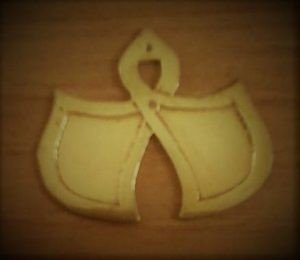 THE JEWELRY : The shape of the double axe (symbol of power and authority) in relief is rendered abstractly. It looks as if its edges have been joined into a completely separate shape to symbolize the power of the Amazon Queen and evolves into a long necklace that can also be worn as a belt to perfectly respond to the performance of this important myth.
THE CATTLE OF GERYON
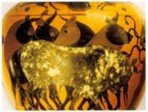
Amphora, 530 BC, National Library, Paris.
Geryon , son of Chrysaor and the Oceanid Callirhoe, was king of Tartessus in Spain and was reputed to be the strongest man in the world. He was born with three heads, six arms, and three bodies joined at the waist. His cattle were guarded by the herdsman Eurytion, son of Ares, and the two-headed shepherd dog Orthros (formerly belonging to Atlas), child of Typhon and Echidna. Heracles was tasked with bringing this herd from Erytheia, an island in the Ocean, without begging or paying for it. The feat is divided into two parts: a) the capture of Geryon's oxen and b) the return with the oxen to Mycenae.
In the first, Hercules crossed all of Europe to Iberia, crossed into Africa, and along the way he killed many wild beasts and criminals and freed many people. Finally, he ended up in Tartessus, in the strait that separated Europe from Africa, where he erected two pillars, one opposite the other on the two banks of the strait, the Pillars of Hercules (in present -day Gibraltar ).
When he reached the shore of the Ocean, tired, he sat down to ponder how he would cross to the island of Erytheia where Geryon's oxen grazed. Then the Sun appeared to descend on his golden chariot towards the west into the Ocean. The Sun shone so brightly on Hercules that it blinded him and the unbearable heat angered him and he took his bow and shot an arrow at the god. He was angry, but accepted the apology that Hercules later asked for and lent him a solid gold cup, the Depas, in which Hercules sailed to the island. Arriving there, Orthros attacked him and Hercules killed him with his club. Then Hercules tried to take the herd, but Geryon arrived, notified by the Menoite who was grazing Hades' oxen nearby. Then Hercules pierced Geryon's three bodies with his arrows, wounded Hera in the chest, who rushed to his aid, and sent her fleeing. Thus Hercules obtained Geryon's oxen, boarded the golden cup of Helios, which brought him back to Tartessus, where Hercules gratefully returned it to the god.
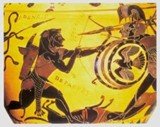
Hercules fighting Geryon. Chalkidian amphora, 530 BC. Paris National Library
In the second part of the myth it is said that on his return he crossed Abdera and then in Spain, where he left some of his entourage as settlers. In the Pyrenees he courted and buried the princess Pyrenees, from whom the Pyrenees mountains took their name, when he began to search for her by calling out her name. He then visited Gaul, where he abolished the barbaric habit of the natives of killing strangers. He won many friends and founded Alesia (wandering), in memory of his travels. The Gauls for centuries believed that they derived their origin from the union of Hercules with the Galatian princess.
Then on the way back he killed the robbers Ialevio and Dercynus, children of Poseidon, passed through the Alps , Etruria , Tyrrhenia and reached the peninsula that was later called Italy . When he reached the Albourgo river – later the Tiber – he was attacked by Cacus, a robber-monster, who spewed fire from his mouth and stole his oxen. But Hercules found him, killed him and took back his herd. The locals wanted to thank Hercules and he was welcomed by the exiled king of Arcadia, Evander, from whose people Hercules learned the use of letters, and for this reason they built him a common altar with the Muses. According to the Romans, he saved Evander from the taxation imposed on him by the Etruscans and killed King Faunus , with whose daughter he had Latinus, ancestor of the Latins. However, the Greeks believed that Latinus was the son of Circe and Odysseus , and that Hercules founded Pompeii and Heraclea.
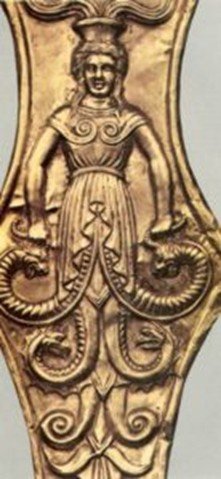
The Snake Woman, 4th century BC. Gold plating of a Horse's forehead. Leningrad, Hermitage
Continuing on, Hercules reached Rhegium, where Eryx, son of Poseidon, stole a bull from him. Hercules left his herd with Hephaestus to guard it and went to find the bull. To get it, he had a boxing match with Eryx, defeated him three times and finally killed him.
When, after many adventures, Hercules arrived in Epirus via the Adriatic, Hera sent a fly to the herd, which enraged the animals, which split into two. One herd went to the mountains of Thrace and the other went even further east. Hercules laboriously gathered the enraged animals again.
In the region of Hylaia, in Scythia, his mares disappeared. While searching for them, he met a woman who was a snake from the hips down, and she told him that she had taken his mares, but in order to return them to him he had to become her lover. Hercules accepted and the snake-woman kept him there until she became pregnant by him. Then she gave him back his mares and asked him what his three children, who she was carrying in her womb, should do when they were born. Hercules told her that when they grew up, he would give them to bend his bow and to wear his belt from the buckle of which a golden bottle hung, and whichever of the three succeeded would become the king of that country, while the other two would have to leave. When the children later grew to manhood, the youngest of the three, Scythians, succeeded and became ruler of the country that has since been called Scythia. The descendants of Scythians honored Hercules as their ancestor and always had a bottle in their belt.
According to others, the daughter of King Briton, Celtini, fell in love with him and hid his oxen until he was united with her. From this union, Celtus was born. She left him his bow, which, when he grew up, if he could draw it, he would become King of the Celts. The story is a copy of the one told by Herodotus about the snake woman.
Then, crossing Epirus, he was attacked by Celts, Chaonians, Thesprotians and Epirotes, but Hercules defeated them all and eventually arrived with Geryon's oxen at Mycenae, where Eurystheus sacrificed them to Hera.
The figure of Hercules in this myth gives another glory to local traditions and may have taken the place of local heroes. He transcends boundaries and becomes the bearer and creator of civilization and the redeemer of people all over the world. One explanation for the cup used by Hercules is based on the fact that large golden cups were called helios ships and some types of ships were called vessels, and according to this Hercules traveled in a type of ship called "depas". The cup symbolizes the drink of life, immortality, abundance, which for the ancient Greeks and Romans is an attribute of Hercules. The oxen symbolize the goods of the world that Hercules liberated by spreading civilization throughout the world, freeing enslaved peoples, killing robbers and tyrants, and recreating morals and cultural standards.
Symbolism: An extraordinary feat whose myth symbolizes the spread and influence of Greek culture in Europe and the world.
The name of the island Erytheia, meaning the Divine Word, is a mythical name for the land of the dead and the island is located in the West, where the sun ends its daily journey to the world of the living. Erytheia also means red land, from the color that the horizon takes on at sunset. Hades grazes his flock on the island with Menoitis as shepherd. Geryon therefore belongs to the figures of the Underworld. In the frescoes of the Tomba dell Orco in Cotneto he appears standing like a satellite next to the throne of Hades and Persephone.
The ox is a symbol of fertility, because it was used to cultivate the land. It is no coincidence that in this particular feat it passes through all of Europe and "cultivates" civilization. It taught them letters, respect for the gods and the application of laws. It became the figure of the Genarch from whom everyone boasts that they are descended (Gauls, Latins, Celts, Scythians). It symbolizes the tendency that man must cultivate for the spread of civilization.
Knowledge of the world, an open mind, and the dissemination of knowledge help human existence evolve and progress.
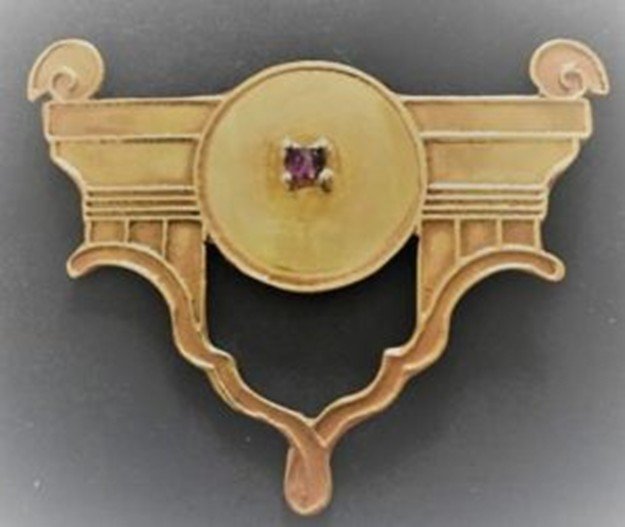 This feat is represented as a jewel by a pendant that bears in relief the Pillars of Hercules and between them the circle of the sun. On the one hand, to symbolize the course of Hercules to the ends of the world, on the other hand, to remind us of the spread of the principles of Greek civilization, which like the sun illuminated and influenced humanity. This pendant is held by tourmaline stones that with their charming colors travel you to a world where a rainbow illuminates it, dissolving everything dark.
THE APPLES OF HESPERIDES
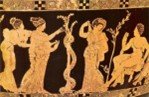
The Apples of the Hesperides. Red-figure Hydra, 410 BC. London.
Hercules accomplished the first ten labors, but Eurystheus did not recognize the second and fifth (the Lernaean Hydra and the stables of Augeius) and so imposed two more on him. The eleventh was to bring him fruits from the Golden Apple, a wedding gift to Hera from her mother, who was so pleased that she planted it in her divine garden where the daughters of Night, the beautiful Hesperides, also lived. In Greece, they believed that the Garden of the Hesperides was located on the slopes of Mount Atlas, where the horses harnessed to the chariot of the Sun end their journey. According to another version, it was in the land of Hyperboreans, otherwise in northwest Africa and finally for some that it was in the Peloponnese.
Once Hera noticed that the Hesperides, to whom she had entrusted the guarding of the tree, were stealing apples. So she ordered the vigilant dragon Ladon to wrap himself around the trunk of the tree and guard it. Ladon, the child of Phokros and Cetus, was a huge snake with a hundred heads, a scarlet back, who made all kinds of noises and never slept.
Hercules, not knowing where the garden of the Hesperides was, went north and reached the river Eridanus where the Nymphs, daughters of Zeus and Themis, lived, and learned from them that only Nereus, the old man of the sea, knew how to show him the way. Hercules searched everywhere and found Nereus with whom he had to fight, which was not easy, because he constantly changed forms to escape from Hercules' grip. He became a snake, a river, a bull, fire, but he could not escape and was forced to reveal to Hercules the secret path to the garden and, in addition, he advised him to remember that "true knowledge lies within himself".
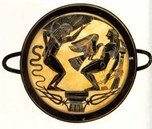
Atlas supports the sky and the eagle eats the entrails of Prometheus, 550 BC Vatican Etruscan Museum
Then Hercules had to cross all of Libya, where he met the giant Antaeus, who forced passers-by to fight with him and killed them. He wanted to do the same with Hercules, but he understood that the giant drew his strength from his contact with his mother Earth, lifted him up and when he lost his strength he drowned him.
Then he arrived in Egypt, where on the banks of the Nile, while he was sleeping, the soldiers of King Busiris tied him up, so that he could offer a sacrifice to Zeus, as he was urged by the oracle of the seer Phrasius from Cyprus, who said that the nine-year drought that had fallen on the country would stop if Busiris sacrificed a stranger to Zeus every year. In front of the altar, Hercules broke his bonds, killed Busiris as well as his son Amphidamas and thus freed Egypt from the cruel king. According to another version, Busiris had kidnapped the Hesperides who were daughters of Atlas and Hercules, killing Busiris, freed them.
From there he went to Ethiopia, whose king, Himathion, tried to prevent him from continuing his journey. Hercules killed Himathion and continued on north to the Caucasus where he found Prometheus chained to a rock. Zeus, to punish him for stealing fire and giving it to people, had him chained and an eagle visited him every day and ate his liver. Hercules, after consulting with Zeus, killed the eagle and freed Prometheus, who advised him not to cut the apples himself, but to put his brother Atlas, who held the celestial sphere on his shoulders, to do it. Because Prometheus' punishment was eternal, his release was made on the condition that he wear, as a sign of his captivity, a ring made from his chains and decorated with the stones of the Caucasus! The first ring with a stone in the world!
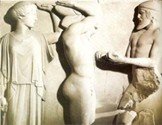
Hercules and Atlas, 460 BC Ancient Olympia, East Pediment (detail) of the Temple of Zeus
Then, Hercules arrived at the Garden of the Hesperides and suggested to Atlas that they change positions, so that he could cut the apples for him, since Ladon would not attack him. Atlas gladly accepted and soon returned with the apples, only he told Hercules that he would take them to Eurystheus. Hercules pretended to agree, but begged Atlas to hold the celestial dome for a while, so that he could place a pillow on his head. Atlas believed him, put down the apples and took the sky back on his shoulders.
Hercules then took the apples and left. In another variation of the myth, Atlas simply showed him the way to the Garden of the Hesperides and he went alone, killed (or put to sleep with the help of Medea or the Hesperides) Ladon and took the apples. Zeus, to honor Hercules' feat, turned the snake into a constellation. After a few months, he delivered the apples to Eurystheus, who returned them to him, and then he gave them to Athena, who in turn returned them to the Nymphs, because it would be illegal for her to have something that belonged to Hera.
The feat is mentioned by Sophocles and Euripides in their works "Trachiniae" and "Hercules" respectively, where they claim that Atlas took the apples.
Symbolism: With this specific feat, Hercules' cultural work continues on the other side of the Mediterranean, in northwest Africa, Asia, and the Caucasus, to close the circle to the land of the Hyperboreans.
The tree of wisdom with the golden apples of the Hesperides, symbolize knowledge (they remind us from the Old Testament, of Adam and Eve with the apple of knowledge and the serpent-dragon). In his fight with Antaeus, who had the form of a serpent (of earthly knowledge), in order to defeat him he had to isolate him from his powerful earthly nature, using the divine mind. After carrying the weight of the world on his shoulders (Atlas), after offering services to those who suffered (Prometheus), after being freed from the lie of misinformation (Busiris) and after many other wanderings, the truth that Nereus had told him that "true knowledge lies within him" shone within him and he was deemed ready to touch the "apples of knowledge and wisdom", which he held for a while and then returned to the tree of knowledge through the goddess of wisdom Athena.
The apples symbolize love, fertility, health, wisdom, knowledge, immortality and speech. After what he did and offered, Hercules was ready for the journey of immortality. Their return from Eurystheus symbolizes and concerns those who are not worthy of this knowledge and thus cannot acquire it. The names of the Hesperides, who guard the apples of the magical Tree of Life, are: “Aegli” = Heavenly and luminous, “Arethusa” = Supreme truth, “Hestia” = Spiritual fire. Hera had also assigned the guarding to the Dragon, son of Typhoeus and Echidna (echidna ). An important meaning of the feat is that Bright words and knowledge should not be kept by the worthy possessor but should be gifted with wisdom to his fellow human beings.
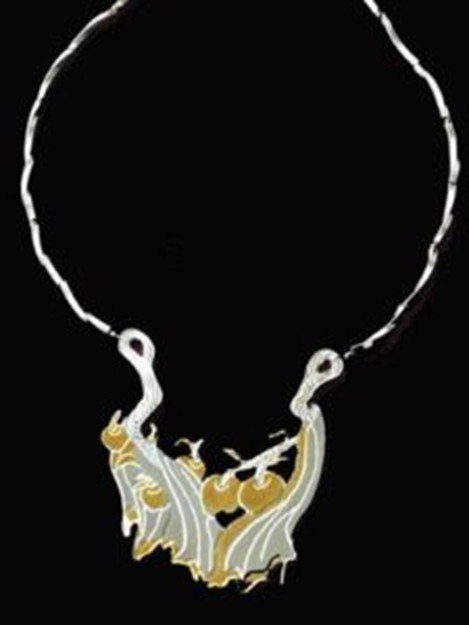 This feat is represented as a jewel with an impressive pendant whose main theme is embossed with symbolic shapes such as golden apples in a beautiful complex with the veils of the hesperides in alternations of silver and gold. The set is complemented by earrings of the same shape.
THE CAPTURE OF CERBERUS
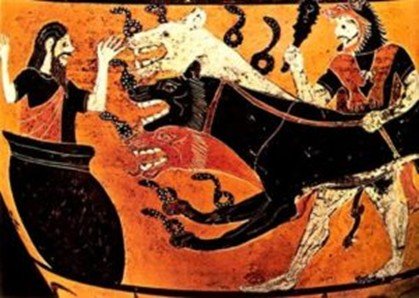
Hydra, Hercules leading Cerberus to Eurystheus, 520 BC Paris Louvre Museum.
The last and most difficult labor of Hercules was to transport Cerberus from Tartarus.
Before starting his journey to the underworld, Hercules went to Eleusis, where he asked Eumolpus (founder of the Eleusinian Mysteries) for permission to take part in the Mysteries and wear a myrtle wreath. However, only Athenians could be initiated into the mysteries, so they suggested that he be adopted by someone named Pylios. However, since Hercules could not take part in the Mysteries, because he had killed the Centaurs and had his hands stained with the blood of innocents, he had to be purified beforehand.
Because the Eleusinians did not want to deny him his participation in the Mysteries, they founded the Lesser Eleusinian Mysteries for his sake.
From then on, two festivals of the Eleusinian Mysteries were organized every year: the Great in honor of Demeter and the Small in honor of her daughter, which were also preparatory to the Great Mysteries.
His purification was undertaken by Eumolpus (symbolizing good radiance and power, molpi = psalm, ode). Thus, now pure, he was initiated by the then Priest of the Mysteries, Musaeus, the son of Orpheus.
Purified and prepared, Heracles, guided by Athena and Hermes, descended into Tartarus from a cave beneath a temple of Poseidon, at Cape Tainaro in Laconia. There he met Charon, who transported him to the other bank of the Styx, where he met Meleager, to whom he promised that, when he returned to the upper world, he would marry his sister Deianeira.
When Hercules presented himself to Pluto and asked him to take Cerberus, he became angry and told him that in order to take him he had to defeat him with only his hands, without weapons. Hercules, after searching for a year, found Cerberus chained at the gates of Acheron and after a great hand-to-hand fight, managed to subdue him. He tied him up and set off for the upper world. But Pluto did not keep his promise and tried to stop him. Then Hercules wounded him with one of his arrows and he was afraid and gave him permission to leave.
Returning from Tartarus, Hercules wove a wreath from the leaves of the tree that Hades had planted in memory of his beautiful nymph mistress Lefka in the Elysian Fields. The outer leaves of the wreath remained black, because this is the color of the underworld. However, the leaves that were near Hercules' forehead and eyebrows turned a silvery-white hue from his sweat. That is why they dedicated to Hercules the White or Weeping Lefka, whose color symbolizes that he had acted in both worlds.
With the help of Athena, he crossed the Styx river and reached the exit of the underworld, which was located in Troezen.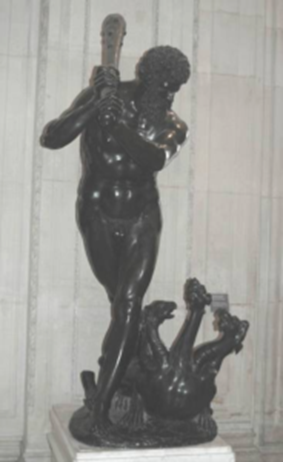
Finally, Heracles brought Cerberus to Eurystheus and was freed from his obligation to him, who again hid from his terror in the bronze jar. Heracles returned Cerberus to Hades as he had promised Pluto and Eurystheus made a sacrifice to Zeus, but gave Heracles a portion of a slave and the best parts to his relatives. Heracles then became very angry and killed the three sons of Eurystheus: Perimedes, Eurybius and Eurypylus.
Symbolism: Cerberus was considered a symbol of evil spirit by the Neoplatonists. The three heads of Cerberus probably depict the triune dark deity called Hecate. Since this is a form of the underworld, the antithesis of the surface we live on, we can assume that it is the negative dimension of the three forms that constitute our existence: the mind, the soul, and the material body. The snakes that cover the tail and heads of Cerberus express the delusion that dominates the form of this earthly matter (something that is characteristically expressed by the snake in the Christian paradise).
The white Lefka signifies the Elysian Fields and the black one Hades, so it is an emblem of Zeus and Hercules. The victory over the monster represents the triumph of good over evil, of light over darkness.
The core of the myth is known from the Homeric epics. The descent into Hades is his path towards death and his struggle to confront and defeat it in order to change his own fate by gaining immortality. The abduction of Cerberus has the meaning that Hercules dominates death. The Lefki that he brings with him is a symbol of birth.
Hercules once again with courage, perseverance and his own strength alone emerges victorious. Symbolically, he defeated the death of the soul. The path of the soul towards its deification is incredibly difficult. But whoever endures the battle with evil will surely defeat it, the light will purify his soul and bring it closer to its Creator.
This feat comes as a jewel, and a simple Topaz, loosely tied, symbolizes the light that dispels the darkness of death.
THE AFTERMATH OF THE ATHLES AND THE DEATH OF HERAKLES.
After the 12 labors, Hercules left and settled in Tiryns. However, Hera, with her unquenchable hatred against him, continued to pursue him.
When the king of Oichalia in Euboea promised to give his beautiful daughter Iole to whoever defeated him in an archery contest, Heracles took part in the contest and won. However, Eurytus refused to give him his daughter, saying that he refused to give her to a former slave of Eurystheus.
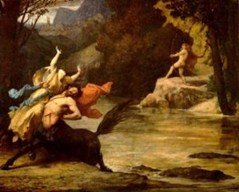 Hercules, who had fallen in love with the beautiful Iole, left in sorrow and went to the king of Aetolia, Oeneas, and asked to marry his daughter Deianeira, as he had promised Meleager when he had gone to the underworld. A few days after the wedding, he left with his wife to return to Tiryns. Arriving at the river Evinus, he met the Centaur Nessus, who was ferrying travelers to the other side of the river for a fee. Then Hercules put Deianeira on Nessus's back and he swam across the river. However, Nessus, enchanted by Deianeira's beauty, tried to abduct her, but Hercules hit him with one of his deadly arrows and killed him. Shortly before Nessus died, in order to avenge Heracles, he told Deianeira to collect his blood, which contained the poison of the Lernaean Hydra, and if Heracles ever strayed from her, to wet a tunic with it and give it to him to wear, and then Heracles would return to her and would never be interested in another woman again. Deianeira kept the blood and they continued their journey to Tiryns.
After a while Eurytus accused Heracles of stealing his flocks, which in reality had been stolen by Autolycus. Eurytus' son, Iphitus, did not accept that Heracles was a thief and went to find him in Tiryns to prove his innocence. Heracles received Iphitus with great joy, but one day Hera sent him a rage, reminding him of Eurytus' insult, and Heracles, beside himself, killed Iphitus by throwing him off the city walls.
Zeus was enraged because his son violated the sacred custom of hospitality and decided to punish him harshly by sending him a severe and torturous illness. Hercules, after much suffering, received an oracle from the Pythia that in order to escape the illness he had to be sold as a slave for three years, and the money he would receive had to be given to Eurytus to ransom his son's life. This angered Hercules and brought him into conflict with the god Apollo.
Thus he was sold as a slave to Queen Omphale of Lydia, who fell passionately in love with him but this did not prevent her from treating him humiliatingly, insultingly and slandering him. From this union was born Lamus (the surname of Lamia). The ambition of the Lydian kings to genealogically connect their dynasty with descendants of Hercules also played a role in the myth.
The name of Omphalos is associated with the Delphic Omphalos and is considered the personification of the Oracle at which Hercules was supposed to serve. When Hercules recovers from his illness, he is carried away by passion and responds, but quickly finds himself again. Through this myth, he clearly states that he was freed from worldly things, and his soul, incorruptible, continued on the path of seeking self-knowledge and perfection. Then he also took part in the Argonaut expedition, until the three years were completed and his punishment ended.
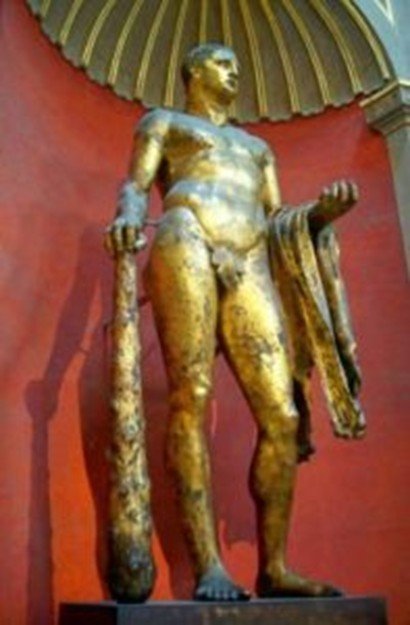 On his return to Tiryns, Hera sent him a terrible storm, at the same time asking the god Sleep to put Zeus to sleep so that he would not realize what was happening. Hercules was carried by the waves to Kos, where he killed King Eurypylus who attacked him. Meanwhile, Zeus woke up, learned what Hera had done, became very angry, and to punish her, he tied her with golden chains and hung her alone ("Ira moneis") airless between heaven and earth, after first placing heavy anvils at her feet. The Italians recorded this story on their coins and called them moneta (which means alone) hence the current French mone and the English money , demonstrating the universal and timeless power of the Greek language.
While Hercules was still on Kos, Zeus sent Athena to summon him to help in the fight against the Giants, who were invulnerable to the weapons of the gods but vulnerable to those of mortals. Hercules undertook to help the gods and with his bow destroyed the Giants. For this help, Zeus named him "Olympian".
Then Hercules went to Oichalia with his army, captured it and took many prisoners. Among them was Iole, with whom he fell in love. During the three and a half years of his absence, his wife Deianeira had been worried about his life. So she joyfully welcomed the news of his imminent arrival from the messenger Lichas. However, when she learned from a slave that Hercules, coming, intended to make the captive Iole his wife, for whose love she had taken part in the archery games of Eurytus, Deianeira was very hurt because she would lose the man she loved. Then she remembered the blood of Nessus and the words he had said to him, without knowing the existence of the poison of the Lernaean Hydra that was in it. So he took the new tunic he had made for Hercules, dipped it in the blood of Nessus and sent it to him with Lichas to wear during the sacrifices he would make to the gods. Hercules put on the tunic and it stuck to his skin and the poison began to cause him unbearable pain. When Deianeira realized what she had done, she took a double-edged sword and committed suicide. Hercules learned from his son Hyllus about Nessus' revenge and asked him to take him to the top of Oite and burn him on a large altar to redeem himself from the unbearable pain. However, none of his friends agreed to light the fire, until Philoctetes came, who lit it in exchange for his bow and arrows. Then Athena appeared on a golden chariot and took him to Olympus, where, having become immortal, he lived among the gods. According to one version, when Iolaus' friends went to collect the bones, they found nothing and took them with them. Αs the oracles had foretold, he passed into the dance of the immortal gods. After his deification, Zeus convinced Hera to adopt Hercules and to surround him from then on with maternal love. In order to perform the adoption, Hera climbed onto a bed and, pulling Hercules onto her body, let him fall to the ground through his clothes, thus representing the true birth. Then she gave him as his wife her daughter Hebe, the beautiful goddess of youth.
Athena leads Heracles to Immortality, on Mount Olympus. Red-figured Pelice, 450 BC Munich
The path to immortality is over. The purpose has been fulfilled. Man, freed from the delusions of ephemeral earthly matter, cleansed of personal weaknesses and passions, can now enjoy the goods and happiness of spiritual moral life and eternal life.
Hercules in general, regarding the historical interpretation of his labors , is associated with a series of hydraulic works, which date back to the Mycenaean world and concern the management of water with the aim of draining the marshes and creating arable land. In Nemea, where ancient sources are mentioned, the fact that he closed one end of the cave (tunnel) with stones probably means that he created a kind of dam. Perhaps it is no coincidence that the most impressive hydraulic works of prehistoric Europe are found in Kopaida, in Lerna next to Argos and in Stymphalia, in the valley of the Feneus.
The influence of Hercules
Hercules emerged as a model ruler, striving for the good of humanity, as well as a role model for the common man.
The Dorians, who returned and settled in the Peloponnese in the 11th - 10th centuries BC, were also called "Heracleides" because they were considered his descendants, who had been expelled by Eurystheus after the Hero's deification.
He is considered the founder of the Olympic Games and determined the length of the stadium from the size of his foot (192 m. = 600 feet, i.e. 0.32 cm. per foot). The great athletes of wrestling imitated him in the Pygmy and Pancratius events. The winners were called first or second or ... fifth etc. "of Heracles" since he was the first to achieve this victory. In the Prytaneum they sang the "Hymn to Heracles".
The Pythagoreans held him up as a model of virtue and perseverance.
Alexander the Great said, “ I imitate Hercules, I admire Perseus, and I seek the traces of Dionysus… ” (Plutarch, “Ethics”) and gave the name Hercules to his first son. Hercules was worshipped as a god in the Macedonian palace in Vergina.
The Roman Mark Antony claimed that he was not only a descendant of Hercules but also resembled him in appearance.
Commodus and Caracalla dressed like Hercules.
He was worshipped as a god and the most common invocation was " Oh! Heracles !", as we say today " My Christ ".
The Etruscans worshipped him as a healer and protector of Nature, and in Roman Italy they associated the name Italy, meaning "land of oxen", # with the oxen of Geryon.

Cameo, 307 AD Constantine the Great with a lion's head
He was worshipped everywhere during the period of the Roman Empire and his cult spread to present-day France, Spain, Germany and Hungary.
In Byzantium, he was considered a symbol of natural strength and a performer of miraculous works. His figure appears in art and his myths in literary texts of the time.
Christian thought initially rejects it . Then it makes an attempt to integrate it into Christian positions and interprets the ancient tradition as a harbinger of Christianity or as a moral philosophy.
In the West during the Middle Ages and the Renaissance, mythology was used as tradition and teaching, while during the period of Turkish rule in Greece, it continued, through Greek scholars and travelers, to be an element of education and a means of teaching ancient texts.
At the beginning of the 19th century , when intensive teaching of ancient Greek was introduced into education, Hercules was a cultural model and a source of inspiration for both oral and popular art. We will see him in paintings by contemporary painters such as Kontoglou, Hadjikyriakou-Ghika, Parthenis, or even in popular artists such as Theophilos, but also as a subject in Karagiozis.
Finally, in astrology, the 12 feats were associated with the 12 zodiac signs, but there are different opinions about the correspondence between them.
"Heracles" means " the glory of Hera ", i.e. "the glory of Hera" and allegorically is "the struggling hero of sunlight".
Nikos Kazantzakis wrote about him: "The ascetic hero, who performed the feats to work his heavy flesh and to be lightened from matter and become a god. This inner meaning of the myth possesses me completely and stands before me as the supreme model of virtue."
Hercules, his life and his Labors symbolize the course of GREECE and the spread of Greek Culture to the ends of the world throughout the centuries. His ascension and establishment on Olympus symbolize the passage into eternity of the unique Greek nation and culture, through countless difficulties. GREECE must fight and face the "beasts" that it has often trusted, and they have devoured it. However, no beast has ever managed to take away its spirit and ideals and will never succeed. It will continue to cultivate and generously spread culture throughout the world as it has always done.
Every time the path to Olympus is very difficult, but its peak belongs to her. It is her divine mountain that no other mortal people can face!
BIBLIOGRAPHY
1. "Greek Mythology", Kakridis, "Athens Publishing" publications 1986.
2. "Greek Mythology", D. Decharme of the French Academy, "Useful Books" publications 1959.
3. "Greek Myths" Robert Graves, "Cactus" publications, 1998.
4. "Decoding the Labors of the Demigod Hercules", Eleftherios Aktoudianakis, "Historiognosia" publications, Thessaloniki.
5. "The Temple of the Muses" by Abbe de Marolle , published by Zacharie Chatelain , Amsterdam 1733.
6. "Hercules the explorer of the ancient world" by Irene Bourdakou, archaeologist, "Free Thought" publications.
7. "Great Greek Encyclopedia" by Drandakis, published by "Pyrsos" 1926.
8. "Ogygia or Archaeology" by A. Stagiritis, published by "Free Thought" 1996.
9. "Hesiod's Excerpts from the Oeans", published by "Papyrus" in 1902.
"Hesiod 's Theogony", "Papyrus" edition, 1902.