
 In Greek Mythology the Nymphs, were deities of the liquid nature and welfare. They were living in the springs, mountains, fields, woods and trees, accordingly taking names respectively as: Nereids, Orestiades, Agronomists, Dryads or Amadryades etc. They were female young figures who were living in the wild nature, wandered in mountains accompanied the goddess Artemis and played with her. They were very beautiful virgins with brilliant whiteness skin and their hair were adorned with spring flowers. They sang and danced along with Pan in the meadows, slopes and usually near by the springs.
They had as relatives, renowned gods and believed that god Hermes were of the Nymph’s Maia son.Homer considered that they were the daughters of “Aigiochos Zeus”, the god of storm, and they participated in the meetings of gods. Others believed that they were rivers’s daughters: either of the longest river in place, the Ocean, or the Achelous, or of a local river in a region.So, each region had its rivers, and each of them had given birth to the nymphs in this region. For example: the river Peneus was father of the nymphs of Thessaly and the river Xanthus was father of the nymphs of Troy. Very often were given their names to nearby cities, as was happened by the Nymph Sparta, which was the river’s Eurotas daughter. But there were some nymphs which called Melies and were born from the drops of blood of Uranus, which fell on Earth, when his son Cronus cut off his genitals.
So the nymphs came into three categories: 1) The Naiads, ie the Nymphs of the rivers, springs and fountains, which are the best-known, 2) The Orestiades, who lived in the mountains where there are sources and 3) The Amadryades or Dryads, Nymphs of solitary trees and meadows and identified with the Melies.The Naiads lived in caves, located near the water or in it and beneath the surface of rivers. Inside the caves were enjoying the pleasures of love with Hermes or Silenus. They lived as the sources did, close to which lived and when those were drying up the Naiades put out. The same happened with Amadryades or Dryads, whose name means "tree and woman simultaneously". The pines, firs and oaks began to grow when the life of a nymph began. They were strong trees and lived for many years, while mortals were forbidden to touch them with a hatchet.
According to tradition, the Nymphs were known nannies of many important gods and heroes. They were those who were responsible for raising them when they were very young. They were breastfed them and were replacements of their mothers. First, Zeus was raised by them in Crete, and happed the same by Hera, Persephone, Hermes, Pan and Dionysus. Since then the Nymphs are members of the Dionysiac theater, along with the Satyrs. Aphrodite had confided her son Aeneas, to the Nymphs of the Trojan mountain Ida. Naiades attributed to several properties: they said that they could make thermal the waters of a source, so the mortals offered sacrifices, as honor, to them very often. The most famous cases of Naiads with similar skills were in the Peloponnese and Sicily. There, in the hot springs of Imera, said that Hercules went on to renewed his strength.
 They also believed that Naiads had medical treatment capabilities, especially because of their relationship with Apollo, and the gift of prophesy things to come. In the Sfragidio cave, on Cithaeron, was the oracle of the Nymphs, and many mortals endowed with prophetic abilities, saying that the skills they had received from Nymphs. Also, considered that they were the mothers of many mortal sages, prophets and doctors, such as Chariklo mother of Tiresias, Filira mother of Cheiron and Coronis mother of Asclepius.
The Nymphs were worshiped in many places throughout Greece, but there weren’t temples dedicated to them. The sacrifices made in their honor near springs or in caves. Their worship continued and Romans, who considered them the liquid deities and worshiped in lakes, rivers and springs.
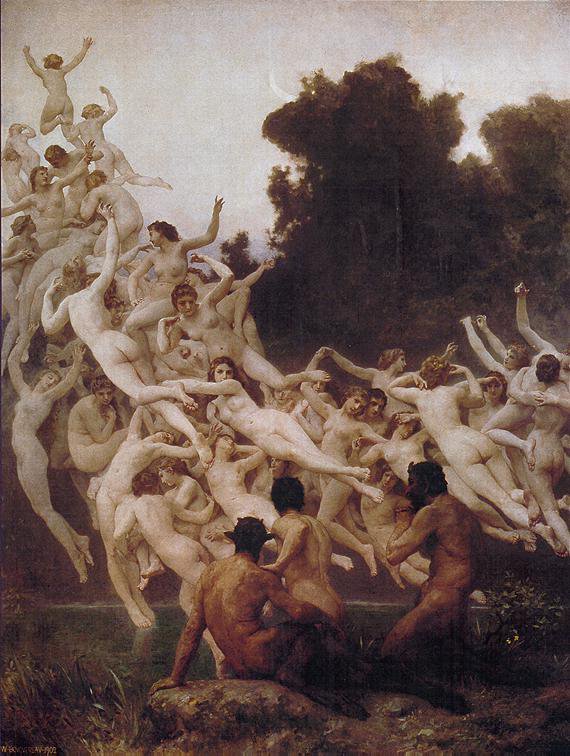
Nymphaeum William-Adolphe Bouguereau (30.11.1825-19.8.1905) Oreades, William-Adolphe Bouguereau (30.11.1825-19.8.1905)
The Nymphs have survived in our folk tradition to this day. They are our familiar fairies, who live in the mountains, in fairy-caves and fairy-springs. It is always considered dangerous to encounter them, as there are still myths about the “fairy-taken”, just like Hylas in antiquity. Only those born on a Saturday and the “light-shadowed” can perceive them and see them dancing.
In art the Nymphs inspired many painters and sculptors and so we find representations of them in many international museums like the Louvre and the Art Gallery of Munich.Usually they depicted as extremely beautiful virgins, naked or dressed, often with floral wreaths in their hair, dancing in a circle around an altar with various deities, either in frantic way around satyrs with Pan.
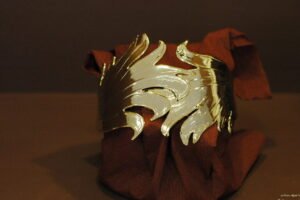
"The wreath crown of Nymphs" is a jewel, inspired by the Nymphs who wants to wake up to the woman who wears it, memories of the eternal feminine charm and grace, which are highlighted by the unique beauty of nature ornaments. To make her feel like a unique "Nymph", which like those, it reflects the joy and happiness of the magical world of myths who coined them.
It attempts to give to woman who wears it an item from the beauty of these mythical creatures who live among mortals and gods and to symbolize the fruitful and invigorating power that exists within every woman and makes Nymphs to live among mortals and gods.